
Textbook Question
13–20. Explicit formulas Write the first four terms of the sequence { aₙ }∞ₙ₌₁.
aₙ = (2ⁿ⁺¹) / (2ⁿ + 1)

 Verified step by step guidance
 04:16
04:16
 05:03
05:03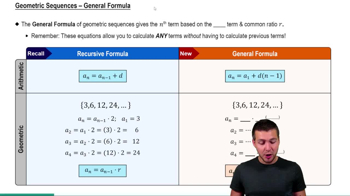 04:45
04:4513–20. Explicit formulas Write the first four terms of the sequence { aₙ }∞ₙ₌₁.
aₙ = (2ⁿ⁺¹) / (2ⁿ + 1)
32–49. Choose your test Use the test of your choice to determine whether the following series converge absolutely, converge conditionally, or diverge.
∑ (from k = 1 to ∞) (−1)ᵏ / √(k³ᐟ² + k)
11–86. Applying convergence tests Determine whether the following series converge. Justify your answers.
∑ (from k = 1 to ∞)k! / (kᵏ + 3)
48–63. Choose your test Determine whether the following series converge or diverge using the properties and tests introduced in Sections 10.3 and 10.4.
∑ (k = 1 to ∞) 1 / ( (3k + 1)(3k + 4) )
9–36. Comparison tests Use the Comparison Test or the Limit Comparison Test to determine whether the following series converge.
∑ (k = 1 to ∞) 20 / (∛k + √k)
32–49. Choose your test Use the test of your choice to determine whether the following series converge absolutely, converge conditionally, or diverge.
1 / 1! + 4 / 2! + 9 / 3! + 16 / 4! + ⋯