Ch. 1 - Functions
Briggs - Calculus: Early Transcendentals 3rd Edition
Briggs3rd EditionCalculus: Early TranscendentalsISBN: 9780136847243Not the one you use?Change textbook
Chapter 1, Problem 56d

Use shifts and scalings to transform the graph of ƒ(x)=xƒ(x)=\(\sqrt{x}\)  into the graph of g. Use a graphing utility to check your work.
g(x)=3x15g(x)=3\(\sqrt{x-1}\)-5

Verified step by step guidance
1
Start with the base function \( f(x) = \sqrt{x} \).
Apply a horizontal shift to the right by 1 unit to get \( \sqrt{x-1} \). This accounts for the \( x-1 \) inside the square root.
Apply a vertical stretch by a factor of 3 to get \( 3\sqrt{x-1} \). This is done by multiplying the entire function by 3.
Apply a vertical shift downward by 5 units to get \( 3\sqrt{x-1} - 5 \). This is done by subtracting 5 from the entire function.
The transformed function is \( g(x) = 3\sqrt{x-1} - 5 \). Use a graphing utility to verify the transformation visually.

Verified video answer for a similar problem:

This video solution was recommended by our tutors as helpful for the problem above.
Video duration:
7m
Was this helpful?

Key Concepts

Here are the essential concepts you must grasp in order to answer the question correctly.

Transformations of Functions

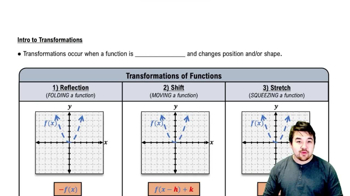
Transformations of functions involve shifting, stretching, compressing, or reflecting the graph of a function. For example, adding a constant to the input (x) shifts the graph horizontally, while adding a constant to the output (f(x)) shifts it vertically. Understanding these transformations is crucial for manipulating the graph of a function like f(x) = √x to achieve the desired form of g(x).
Recommended video:
5:25
Intro to Transformations

Vertical and Horizontal Shifts

Vertical shifts occur when a constant is added or subtracted from the function, affecting its position along the y-axis. Horizontal shifts are achieved by adding or subtracting a constant from the input variable, affecting the x-axis position. In the transformation from f(x) = √x to g(x) = 3√(x-1) - 5, the term (x-1) indicates a horizontal shift to the right by 1 unit, while the -5 indicates a vertical shift downward by 5 units.
Recommended video:
5:25
Intro to Transformations

Scaling and Stretching

Scaling refers to multiplying the function by a constant, which affects the steepness of the graph. A vertical scaling, such as multiplying by 3 in g(x) = 3√(x-1) - 5, stretches the graph away from the x-axis, making it steeper. Understanding how scaling impacts the graph is essential for accurately transforming f(x) into g(x) and predicting the resulting shape of the graph.
Recommended video:
5:25
Intro to Transformations