
Ch. 1 - Functions
Briggs - Calculus: Early Transcendentals 3rd Edition
Briggs3rd EditionCalculus: Early TranscendentalsISBN: 9780136847243Not the one you use?Change textbook
Chapter 1, Problem 55b

Use shifts and scalings to transform the graph of ƒ(x)=x2ƒ(x)=x^2 into the graph of g. Use a graphing utility to check your work.


g(x)=ƒ(2x4)g(x) = ƒ(2x - 4)

Verified step by step guidance
1
Start with the function \( f(x) = x^2 \). This is a basic parabola opening upwards with its vertex at the origin (0,0).
Identify the transformation needed to obtain \( g(x) = f(2x - 4) \). This involves a horizontal scaling and a horizontal shift.
First, consider the expression \( 2x - 4 \). Factor out the 2 to get \( 2(x - 2) \). This indicates a horizontal compression by a factor of 2 and a shift to the right by 2 units.
Apply the horizontal compression: Replace \( x \) with \( 2x \) in \( f(x) \) to get \( f(2x) = (2x)^2 = 4x^2 \). This compresses the graph horizontally by a factor of 2.
Apply the horizontal shift: Replace \( x \) with \( x - 2 \) in \( f(2x) \) to get \( f(2(x - 2)) = 4(x - 2)^2 \). This shifts the graph 2 units to the right.

Verified video answer for a similar problem:

This video solution was recommended by our tutors as helpful for the problem above.
Video duration:
6m
Was this helpful?

Key Concepts

Here are the essential concepts you must grasp in order to answer the question correctly.

Function Transformation

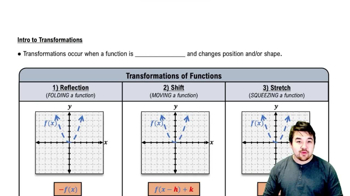
Function transformation involves altering the graph of a function through shifts, stretches, and reflections. In this case, the function f(x) = x² is transformed into g(x) = f(2x - 4) by applying horizontal and vertical shifts and scalings. Understanding how these transformations affect the graph is crucial for accurately sketching the new function.
Recommended video:
5:25
Intro to Transformations

Horizontal Shifts

Horizontal shifts occur when the input of a function is adjusted by adding or subtracting a constant. For g(x) = f(2x - 4), the term '−4' indicates a shift to the right by 4 units. This concept is essential for determining how the graph of the original function moves along the x-axis.
Recommended video:
5:25
Intro to Transformations

Vertical Scaling

Vertical scaling refers to stretching or compressing the graph of a function by multiplying the input by a constant factor. In g(x) = f(2x - 4), the '2' in front of x indicates a horizontal compression by a factor of 1/2. This concept helps in understanding how the shape of the graph changes in relation to the original function.
Recommended video:
1:30
Relations & Functions Example 1