Ch. 1 - Functions
Briggs - Calculus: Early Transcendentals 3rd Edition
Briggs3rd EditionCalculus: Early TranscendentalsISBN: 9780136847243Not the one you use?Change textbook
Chapter 1, Problem 104

{Use of Tech} Triple intersection Graph the functions f(x) = x³,g(x)=3^x, and h(x)=x^x and find their common intersection point (exactly).

Verified step by step guidance
1
Step 1: Understand the problem by identifying the functions involved: f(x) = x^3, g(x) = 3^x, and h(x) = x^x. We need to find the common intersection point of these three functions.
Step 2: Set up the equations for intersection by equating the functions pairwise: f(x) = g(x), g(x) = h(x), and f(x) = h(x). This will help us find the x-values where the functions intersect.
Step 3: Solve the equation f(x) = g(x), which is x^3 = 3^x. This involves finding the x-value(s) where the cubic function equals the exponential function.
Step 4: Solve the equation g(x) = h(x), which is 3^x = x^x. This involves finding the x-value(s) where the exponential function equals the power function.
Step 5: Solve the equation f(x) = h(x), which is x^3 = x^x. This involves finding the x-value(s) where the cubic function equals the power function. The common solution to all three equations will be the intersection point.

Verified video answer for a similar problem:

This video solution was recommended by our tutors as helpful for the problem above.
Video duration:
5m
Was this helpful?

Key Concepts

Here are the essential concepts you must grasp in order to answer the question correctly.

Graphing Functions

Graphing functions involves plotting their values on a coordinate system to visualize their behavior. For the functions f(x) = x³, g(x) = 3^x, and h(x) = x^x, understanding their shapes and intersections is crucial. Each function has distinct characteristics: f(x) is a polynomial, g(x) is an exponential function, and h(x) is a power function, which influences how they intersect.
Recommended video:
5:53
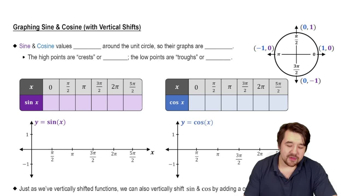
Graph of Sine and Cosine Function

Intersection Points

Intersection points of functions occur where their outputs are equal, meaning f(x) = g(x) = h(x). To find these points, one typically sets the equations equal to each other and solves for x. This process may involve algebraic manipulation or numerical methods, especially when dealing with complex functions like x^x.
Recommended video:
04:50
Critical Points

Numerical Methods

Numerical methods are techniques used to approximate solutions to equations that cannot be solved analytically. In the context of finding intersection points, methods such as the Newton-Raphson method or bisection method can be employed to find roots of the equations. These methods are particularly useful when dealing with transcendental functions like 3^x and x^x, where exact solutions may be difficult to obtain.
Recommended video:
6:47
Finding Limits Numerically and Graphically