Ch. 1 - Functions
Briggs - Calculus: Early Transcendentals 3rd Edition
Briggs3rd EditionCalculus: Early TranscendentalsISBN: 9780136847243Not the one you use?Change textbook
Chapter 1, Problem 108

Design a sine function with the given properties.
It has a period of 1212 with a minimum value of 4-4 at t=0t=0 and a maximum value of 44 at t=6t=6.

Verified step by step guidance
1
Identify the general form of a sine function: y = A * sin(B(t - C)) + D, where A is the amplitude, B affects the period, C is the phase shift, and D is the vertical shift.
Determine the amplitude (A) by calculating the difference between the maximum and minimum values, then divide by 2. Here, A = (4 - (-4)) / 2 = 4.
Calculate the vertical shift (D) by finding the average of the maximum and minimum values. Here, D = (4 + (-4)) / 2 = 0.
Use the given period to find B. The period of a sine function is given by (2π / B). Set this equal to 12 and solve for B: 2π / B = 12, so B = 2π / 12 = π / 6.
Determine the phase shift (C) using the information that the minimum value occurs at t = 0. Since the sine function normally has a minimum at -π/2, set B(t - C) = -π/2 when t = 0, and solve for C. This gives C = π/3.

Verified video answer for a similar problem:

This video solution was recommended by our tutors as helpful for the problem above.
Video duration:
10m
Was this helpful?

Key Concepts

Here are the essential concepts you must grasp in order to answer the question correctly.

Sine Function Properties

The sine function is a periodic function characterized by its amplitude, period, and phase shift. The amplitude determines the height of the wave, while the period defines the length of one complete cycle. Understanding these properties is essential for designing a sine function that meets specific criteria, such as maximum and minimum values.
Recommended video:
06:21
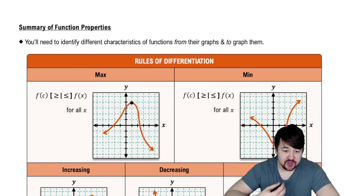
Properties of Functions

Period of a Function

The period of a function is the distance along the x-axis over which the function completes one full cycle. For the sine function, the standard period is 2π, but it can be adjusted by a scaling factor. In this case, a period of 12 means the function will repeat every 12 units along the t-axis, which is crucial for setting the function's behavior.
Recommended video:
6:22
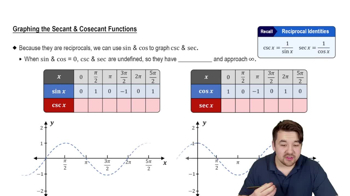
Graphs of Secant and Cosecant Functions

Vertical Shift

A vertical shift in a sine function alters its midline, effectively moving the entire graph up or down. This is important for achieving specific maximum and minimum values. For instance, to have a minimum of -4 and a maximum of 4, the sine function must be vertically shifted down by 4 units, adjusting its range accordingly.
Recommended video:
5:30
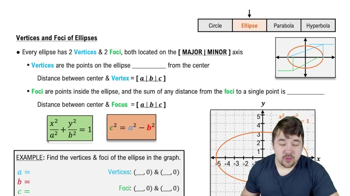
Foci and Vertices of an Ellipse
Related Practice
Textbook Question

Daylight function for 40 °N Verify that the function D(t)=2.8sin(2π365(t81))+12D(t)=2.8\(\sin\)(\(\frac{2\pi}{365}\)(t-81))+12 has the following properties, where t is measured in days and D is the number of hours between sunrise and sunset.


D(81)=12D(81) = 12 and D(264)12D(264) ≈ 12  (corresponding to the equinoxes).

2
views

Textbook Question

Daylight function for 40 °N Verify that the function D(t)=2.8sin(2π365(t81))+12D(t)=2.8\(\sin\)(\(\frac{2\pi}{365}\)(t-81))+12 has the following properties, where t is measured in days and D is the number of hours between sunrise and sunset.


Its maximum and minimum values are 14.8 and 9.2, respectively, which occur approximately at t=172t= 172  and t=355t = 355, respectively (corresponding to the solstices).

7
views
Textbook Question

Area of a circular sector Prove that the area of a sector of a circle of radius r associated with a central angle θ\(\theta\) (measured in radians) is A=12r2θA=\(\frac\)12r^2\(\theta\).

<IMAGE>

Textbook Question

{Use of Tech} Triple intersection Graph the functions f(x) = x³,g(x)=3^x, and h(x)=x^x and find their common intersection point (exactly).

2
views
Textbook Question

Beginning with the graphs of y=sinxy=\(\sin\) x or y=cosxy=\(\cos\) x, use shifting and scaling transformations to sketch the graph of the following functions. Use a graphing utility to check your work.

q(x)=3.6cos(πx24)+2q\(\left\)(x\(\right\))=3.6\(\cos\[\left\)(\(\frac{\pi x}{24}\]\right\))+2

Textbook Question

Daylight function for 40 °N Verify that the function D(t)=2.8sin(2π365(t81))+12D(t)=2.8\(\sin\)(\(\frac{2\pi}{365}\)(t-81))+12 has the following properties, where t is measured in days and D is the number of hours between sunrise and sunset. It has a period of 365 days.

1
views