Ch. 1 - Functions
Briggs - Calculus: Early Transcendentals 3rd Edition
Briggs3rd EditionCalculus: Early TranscendentalsISBN: 9780136847243Not the one you use?Change textbook
Chapter 1, Problem 40d

The graph of ƒ is shown in the figure. Graph the following functions. <IMAGE>


f(2(x1))f(2(x - 1))

Verified step by step guidance
1
Identify the transformations applied to the function \( f(x) \). The expression \( f(2(x - 1)) \) involves a horizontal scaling and a horizontal shift.
Recognize that \( 2(x - 1) \) indicates a horizontal compression by a factor of \( \frac{1}{2} \). This means the graph will be compressed towards the y-axis.
The term \( (x - 1) \) represents a horizontal shift to the right by 1 unit. This means every point on the graph of \( f(x) \) will move 1 unit to the right.
Combine the transformations: First, shift the graph of \( f(x) \) 1 unit to the right, then apply the horizontal compression by a factor of \( \frac{1}{2} \).
Sketch the transformed graph by applying these transformations to key points on the original graph of \( f(x) \).

Verified video answer for a similar problem:

This video solution was recommended by our tutors as helpful for the problem above.
Video duration:
4m
Was this helpful?

Key Concepts

Here are the essential concepts you must grasp in order to answer the question correctly.

Function Transformation

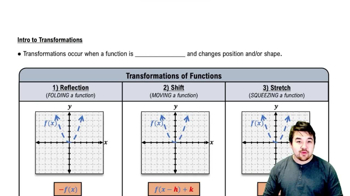
Function transformation refers to the changes made to the graph of a function based on modifications to its equation. Common transformations include vertical and horizontal shifts, stretches, and reflections. For example, the expression f(2(x - 1)) indicates a horizontal shift to the right by 1 unit and a horizontal compression by a factor of 2.
Recommended video:
5:25
Intro to Transformations

Horizontal Stretch and Compression

Horizontal stretch and compression involve altering the width of the graph of a function. A factor greater than 1 compresses the graph, making it narrower, while a factor between 0 and 1 stretches it, making it wider. In the function f(2(x - 1)), the '2' compresses the graph horizontally, affecting how quickly the function values change as x varies.
Recommended video:
5:25
Intro to Transformations

Graphing Composite Functions

Graphing composite functions involves plotting the output of one function as the input to another. In this case, f(2(x - 1)) means we first apply the transformation to x, then evaluate the function f at that transformed value. Understanding how to graph composite functions is essential for visualizing the effects of transformations on the original function's graph.
Recommended video:
3:48
Evaluate Composite Functions - Special Cases