Ch. 1 - Functions
Briggs - Calculus: Early Transcendentals 3rd Edition
Briggs3rd EditionCalculus: Early TranscendentalsISBN: 9780136847243Not the one you use?Change textbook
Chapter 1, Problem 2.24

Taxicab fees A taxicab ride costs \$3.50 plus \$2.50 per mile. Let m be the distance (in miles) from the airport to a hotel. Find and graph the function c(m) that represents the cost of taking a taxi from the airport to the hotel. Also determine how much it will cost if the hotel is 9 miles from the airport.

Verified step by step guidance
1
Identify the components of the cost function: a fixed cost and a variable cost per mile.
Express the cost function \( c(m) \) as \( c(m) = 3.50 + 2.50m \), where \( m \) is the distance in miles.
To graph the function, plot the y-intercept at \( (0, 3.50) \) since this is the cost when \( m = 0 \).
Determine the slope of the line, which is 2.50, indicating the cost increases by \$2.50 for each additional mile.
To find the cost for a 9-mile trip, substitute \( m = 9 \) into the function \( c(m) = 3.50 + 2.50 \times 9 \).

Verified video answer for a similar problem:

This video solution was recommended by our tutors as helpful for the problem above.
Video duration:
5m
Was this helpful?

Key Concepts

Here are the essential concepts you must grasp in order to answer the question correctly.

Linear Functions

A linear function is a mathematical expression that describes a relationship between two variables, typically in the form of y = mx + b, where m is the slope and b is the y-intercept. In the context of the taxicab fees, the cost function c(m) can be expressed as c(m) = 2.50m + 3.50, indicating that the cost increases linearly with distance.
Recommended video:
07:17
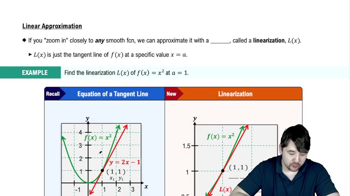
Linearization

Graphing Functions

Graphing functions involves plotting points on a coordinate plane to visually represent the relationship between variables. For the taxicab cost function, the x-axis can represent the distance in miles (m), while the y-axis represents the total cost (c). The resulting graph will be a straight line, illustrating how costs increase with distance.
Recommended video:
5:53
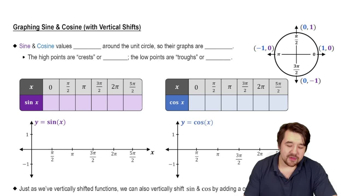
Graph of Sine and Cosine Function

Evaluating Functions

Evaluating a function means substituting a specific value into the function to find the corresponding output. In this case, to determine the cost of a taxi ride to a hotel 9 miles away, we substitute m = 9 into the cost function c(m) = 2.50m + 3.50, allowing us to calculate the total fare.
Recommended video:
4:26
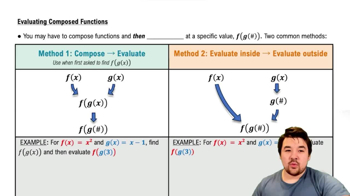
Evaluating Composed Functions