Ch. 1 - Functions
Briggs - Calculus: Early Transcendentals 3rd Edition
Briggs3rd EditionCalculus: Early TranscendentalsISBN: 9780136847243Not the one you use?Change textbook
Chapter 1, Problem 1.17

The National Weather Service releases approximately 70,00070,000 radiosondes every year to collect data from the atmosphere. Attached to a balloon, a radiosonde rises at about 10001000 ft/min until the balloon bursts in the upper atmosphere. Suppose a radiosonde is released from a point 66 ft above the ground and that 55 seconds later, it is 8383 ft above the ground. Let f(t)f\(\left\)(t\(\right\)) represent the height (in feet) that the radiosonde is above the ground tt seconds after it is released. Evaluate f(5)f(0)50\(\frac{f\left(5\right)-f\left(0\right)}{5-0}\) and interpret the meaning of this quotient.

Verified step by step guidance
1
Identify the given information: The radiosonde is released from a height of 666 ft and reaches a height of 8383 ft after 555 seconds.
Recognize that the function f(t) represents the height of the radiosonde at time t. We need to evaluate the average rate of change of the height over the first 5 seconds, which is given by the expression \( \frac{f(5) - f(0)}{5 - 0} \).
Understand that \( f(5) \) represents the height of the radiosonde 5 seconds after release, and \( f(0) \) is the initial height, which is 666 ft.
The expression \( \frac{f(5) - f(0)}{5} \) calculates the average rate of change of the radiosonde's height over the first 5 seconds. This is essentially the average velocity of the radiosonde during this time interval.
Interpret the meaning: The quotient represents the average rate at which the radiosonde's height is increasing per second over the first 5 seconds after its release.

Verified video answer for a similar problem:

This video solution was recommended by our tutors as helpful for the problem above.
Video duration:
4m
Was this helpful?

Key Concepts

Here are the essential concepts you must grasp in order to answer the question correctly.

Function Evaluation

Function evaluation involves substituting a specific input value into a function to determine its output. In this context, evaluating f(5) and f(0) means finding the heights of the radiosonde at 5 seconds and at the moment of release (0 seconds). This process is essential for calculating the change in height over a specified time interval.
Recommended video:
4:26
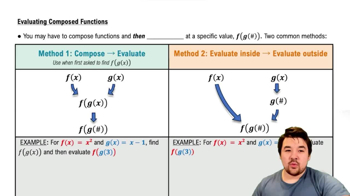
Evaluating Composed Functions

Average Rate of Change

The average rate of change of a function over an interval is calculated by taking the difference in the function's values at the endpoints of the interval and dividing by the length of the interval. In this case, the expression (f(5) - f(0)) / (5 - 0) represents the average rate at which the radiosonde's height changes from the moment it is released to 5 seconds later, providing insight into its ascent speed.
Recommended video:
04:16
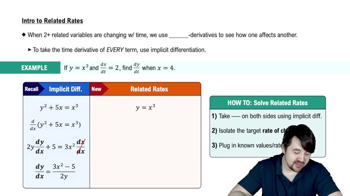
Intro To Related Rates

Interpretation of Results

Interpreting the results of a mathematical calculation involves understanding what the numerical outcome signifies in a real-world context. For the average rate of change calculated, it indicates how fast the radiosonde is rising in feet per second during the first five seconds of its ascent, which is crucial for analyzing atmospheric data collection.
Recommended video:
03:48
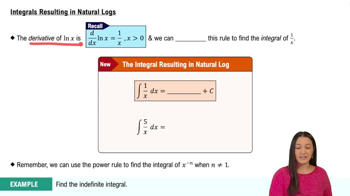
Integrals Resulting in Natural Logs