Ch. 1 - Functions
Briggs - Calculus: Early Transcendentals 3rd Edition
Briggs3rd EditionCalculus: Early TranscendentalsISBN: 9780136847243Not the one you use?Change textbook
Chapter 1, Problem 1.54

More composite functions Let ƒ(x) = | x | , g(x)= x² - 4 , F(x) = √x , G(x) = (1)/(x-2) Determine the following composite functions and give their domains.


G o G

Verified step by step guidance
1
Step 1: Understand the notation \( G \circ G \). This represents the composition of the function \( G(x) = \frac{1}{x-2} \) with itself, meaning \( G(G(x)) \).
Step 2: Substitute \( G(x) \) into itself. Start by replacing \( x \) in \( G(x) \) with \( G(x) \). This gives \( G(G(x)) = G\left(\frac{1}{x-2}\right) = \frac{1}{\left(\frac{1}{x-2}\right) - 2} \).
Step 3: Simplify the expression \( \frac{1}{\left(\frac{1}{x-2}\right) - 2} \). To do this, find a common denominator for the terms in the denominator: \( \frac{1}{x-2} - 2 = \frac{1 - 2(x-2)}{x-2} = \frac{1 - 2x + 4}{x-2} = \frac{5 - 2x}{x-2} \).
Step 4: The expression becomes \( G(G(x)) = \frac{x-2}{5-2x} \).
Step 5: Determine the domain of \( G(G(x)) \). The domain of \( G(G(x)) \) is all real numbers except where the denominator is zero. Solve \( 5 - 2x = 0 \) to find the values to exclude from the domain. Also, consider the domain of \( G(x) \) itself, which excludes \( x = 2 \).

Verified video answer for a similar problem:

This video solution was recommended by our tutors as helpful for the problem above.
Video duration:
3m
Was this helpful?

Key Concepts

Here are the essential concepts you must grasp in order to answer the question correctly.

Composite Functions

A composite function is formed when one function is applied to the result of another function. It is denoted as (f o g)(x) = f(g(x)). Understanding how to combine functions is essential for evaluating composite functions, as it requires substituting the output of one function into another.
Recommended video:
3:48
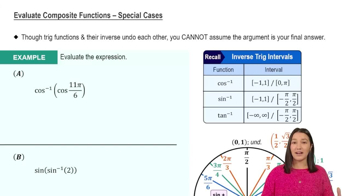
Evaluate Composite Functions - Special Cases

Domain of a Function

The domain of a function is the set of all possible input values (x-values) for which the function is defined. When dealing with composite functions, it is crucial to determine the domain of each individual function and how they interact, as the domain of the composite function may be restricted by the domains of the functions involved.
Recommended video:
5:10
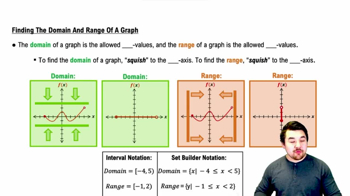
Finding the Domain and Range of a Graph

Absolute Value Function

The absolute value function, denoted as |x|, outputs the non-negative value of x regardless of its sign. This function is important in the context of composite functions, as it can affect the overall behavior and domain of the resulting composite function, particularly when combined with other functions that may have restrictions.
Recommended video:
05:03
Initial Value Problems