 Back
BackVolumes of Solids of Revolution: The Paraboloid Example
Study Guide - Smart Notes
 Tailored notes based on your materials, expanded with key definitions, examples, and context.
Volumes of Solids of Revolution
Solids of Revolution and the Paraboloid
In calculus, a solid of revolution is a three-dimensional object obtained by rotating a two-dimensional curve around an axis. One of the most common examples is the paraboloid, which is generated by revolving a parabola about its axis of symmetry.
Paraboloid: The surface generated by revolving the parabola y = x^2 (or similar) about the y-axis (or x-axis).
Applications: Paraboloids appear in physics, engineering, and geometry, such as in satellite dishes and reflective surfaces.
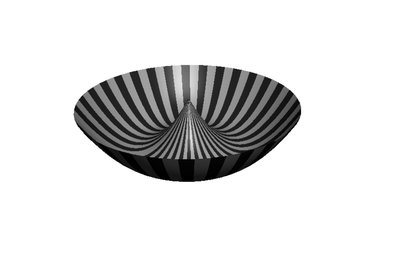
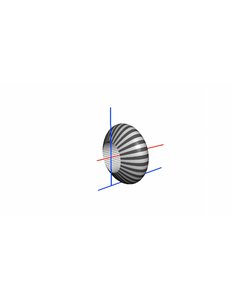
The images above illustrate a paraboloid as a solid of revolution:
The first image (image_1) shows a perspective view of the paraboloid, highlighting its bowl-like shape.
The second image (image_2) shows the paraboloid with coordinate axes, emphasizing the axis of revolution.
Volume of a Solid of Revolution: Disk and Washer Methods
To compute the volume of a solid of revolution, calculus uses the disk method or the washer method:
Disk Method: Used when the solid has no hole (e.g., revolving y = f(x) about the x-axis).
Washer Method: Used when the solid has a hole (e.g., revolving the region between two curves).
Formula (Disk Method):
If the region under y = f(x) from x = a to x = b is revolved about the x-axis, the volume is:
Example: Paraboloid of Revolution
Suppose we revolve y = x^2 from x = 0 to x = r about the y-axis. To express x in terms of y, note that x = \sqrt{y}.
The volume is:
Key Points:
The cross-sections perpendicular to the axis of revolution are circles (disks).
The radius of each disk is determined by the function being revolved.
Integrating the area of these disks along the axis gives the total volume.
Summary Table: Methods for Volumes of Revolution
Method | When to Use | Formula |
|---|---|---|
Disk | Solid with no hole (single function) | |
Washer | Solid with a hole (between two functions) |
Example Application: Calculating the volume of a satellite dish, bowl, or reflector shaped as a paraboloid.
