 Back
BackVolumes of Solids of Revolution: The Paraboloid Example
Study Guide - Smart Notes
 Tailored notes based on your materials, expanded with key definitions, examples, and context.
Volumes of Solids of Revolution
Solids of Revolution and the Paraboloid
In calculus, a solid of revolution is a three-dimensional object obtained by rotating a two-dimensional curve around an axis. One of the most common examples is the paraboloid, which is generated by rotating a parabola about its axis of symmetry.
Paraboloid: The surface generated by rotating the parabola y = x^2 (or z = x^2 + y^2 in three dimensions) about its axis.
Applications: Paraboloids appear in physics, engineering, and geometry, such as in satellite dishes and reflective surfaces.
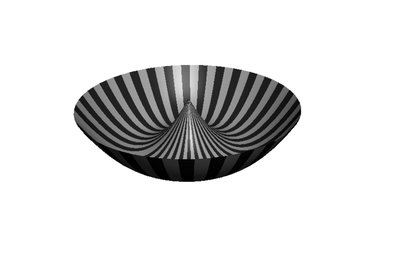
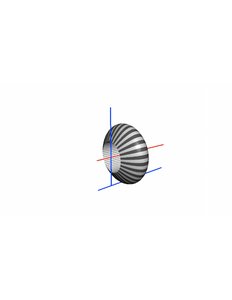
The images above illustrate a paraboloid as a solid of revolution:
The first image (image_1) shows a perspective view of a paraboloid, highlighting its bowl-like shape and symmetry.
The second image (image_2) shows the same solid with coordinate axes, emphasizing the axis of revolution (typically the z-axis or y-axis).
Volume of a Paraboloid by Integration
The volume of a solid of revolution can be found using the disk method or washers method. For a paraboloid formed by rotating y = x^2 about the y-axis from y = 0 to y = h:
The radius at height y is r = sqrt(y).
The area of a cross-sectional disk is A(y) = πr^2 = πy.
The volume is given by the integral:
This formula gives the volume of a paraboloid of height h generated by rotating y = x^2 about the y-axis.
Key Concepts and Definitions
Solid of Revolution: A 3D object formed by rotating a 2D curve about an axis.
Disk Method: Used when the cross-sections perpendicular to the axis of revolution are disks.
Washer Method: Used when the cross-sections are washers (disks with holes).
Paraboloid: The surface or solid generated by rotating a parabola about its axis.
Example: Volume of a Paraboloid
Example: Find the volume of the solid formed by rotating y = x^2 about the y-axis from y = 0 to y = 3.
Radius at height y: r = sqrt(y)
Area: A(y) = πy
Volume:
Summary Table: Methods for Volumes of Revolution
Method | Formula | When to Use |
|---|---|---|
Disk Method | Solid with no hole, rotating around axis | |
Washer Method | Solid with a hole, rotating around axis | |
Shell Method | When integrating parallel to axis of rotation |
