 Back
BackCalculus I: Functions, Limits, Derivatives, and Integrals – Comprehensive Study Notes
Study Guide - Smart Notes
 Tailored notes based on your materials, expanded with key definitions, examples, and context.
Numbers and Functions
Types of Numbers and the Real Number Line
The foundation of calculus is built on the set of real numbers, which include positive and negative integers, rational numbers (fractions), and irrational numbers (such as √2). Real numbers can be represented as points on a number line, and intervals are used to describe subsets of real numbers.
Integers: {..., -3, -2, -1, 0, 1, 2, 3, ...}
Rational numbers: Numbers that can be written as m/n, where m and n are integers and n ≠ 0.
Irrational numbers: Numbers that cannot be written as a simple fraction (e.g., √2).
Intervals: Notation such as (a, b), [a, b), (a, b], [a, b] to describe sets of real numbers between a and b, with parentheses indicating exclusion and brackets indicating inclusion of endpoints.
Set notation is used to describe collections of numbers, and operations such as union (A ∪ B) and intersection (A ∩ B) are fundamental.
Functions and Their Properties
A function is a rule that assigns to each element in its domain exactly one value in its range. The domain is the set of inputs for which the function is defined, and the range is the set of possible outputs.
Piecewise functions: Defined by different formulas on different intervals.
Graph of a function: The set of points (x, f(x)) in the plane.
Linear functions: f(x) = mx + n, where m is the slope and n is the y-intercept.
Vertical Line Test: A curve is the graph of a function if and only if no vertical line intersects the curve more than once.
Inverse and Implicit Functions
Some functions can be defined implicitly by equations involving both x and y, rather than explicitly as y = f(x). The inverse function f-1(x) reverses the effect of f(x), provided f is one-to-one.
Implicit function: Defined by an equation F(x, y) = 0.
Inverse trigonometric functions: arcsin, arccos, arctan, etc.
Limits and Continuity
Concept of a Limit
The limit of a function f(x) as x approaches a value a is the value that f(x) approaches as x gets arbitrarily close to a. The formal (ε-δ) definition ensures precision:
For every ε > 0, there exists δ > 0 such that if 0 < |x - a| < δ, then |f(x) - L| < ε.
Limits can be one-sided (from the left or right) or at infinity. They are foundational for defining derivatives and continuity.
Properties and Computation of Limits
Sum, product, and quotient rules: The limit of a sum/product/quotient is the sum/product/quotient of the limits (when defined).
Sandwich (Squeeze) Theorem: If f(x) ≤ g(x) ≤ h(x) and lim f(x) = lim h(x) = L, then lim g(x) = L.
Continuity: A function is continuous at a if limx→a f(x) = f(a).
Examples and Special Limits
limx→0 (sin x)/x = 1
limx→∞ 1/x = 0
limx→a (xn - an)/(x - a) = n an-1
Derivatives
Definition and Interpretation
The derivative of a function at a point measures the instantaneous rate of change or the slope of the tangent line at that point. It is defined as:
Alternatively,
Geometric and physical interpretations include the slope of a curve and instantaneous velocity, respectively.
Basic Differentiation Rules
Power Rule:
Sum Rule:
Product Rule:
Quotient Rule:
Chain Rule:
Applications and Higher Derivatives
Critical points: Where f'(x) = 0, used to find maxima and minima.
Second derivative: , used to determine concavity and inflection points.
Implicit differentiation: Used when y is defined implicitly as a function of x.
Graphical Applications of Derivatives
Sketching Graphs and Analyzing Functions
Tangent and normal lines: The tangent at (a, f(a)) has slope f'(a); the normal has slope -1/f'(a).
Increasing/decreasing functions: f'(x) > 0 implies increasing; f'(x) < 0 implies decreasing.
Concavity and inflection points: f''(x) > 0 implies convex (upward); f''(x) < 0 implies concave (downward).
Optimization: Use critical points and endpoints to find global maxima and minima.
Exponentials and Logarithms
Exponential and Logarithmic Functions
Exponential function: ,
Natural exponential: , where
Logarithm: is the inverse of
Natural logarithm:
Derivatives of Exponential and Logarithmic Functions
Integrals
Definite and Indefinite Integrals
The definite integral represents the signed area under the curve y = f(x) from x = a to x = b. The indefinite integral represents the family of all antiderivatives of f(x).
Fundamental Theorem of Calculus: If F is an antiderivative of f, then
Properties: Linearity, additivity over intervals, and change of variables (substitution).
Applications of the Integral
Area between curves: where g(x) ≥ f(x)
Volumes of solids of revolution: (disk method), (shell method)
Arc length:
Work: for a variable force F(x)
Physics Applications
Distance from velocity:
Velocity from acceleration:
Visualizing Solids of Revolution
Solids of Revolution and Their Volumes
Solids of revolution are three-dimensional shapes formed by rotating a two-dimensional curve around an axis. The volume of such a solid can be calculated using the disk/washer or shell method.
Disk/Washer Method:
Shell Method:
The images below illustrate solids of revolution, which are central to the application of integrals in finding volumes.
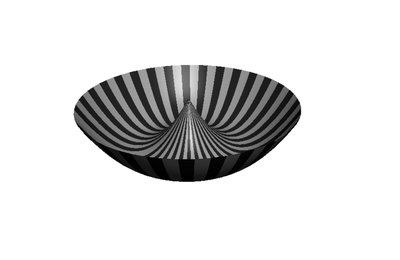
Figure: A bowl-shaped solid of revolution, illustrating the surface generated by rotating a curve about an axis. The vertical stripes help visualize the symmetry and the nature of the surface.
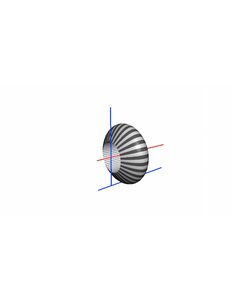
Figure: Side view of a solid of revolution, showing the axis of rotation (red) and the orientation in 3D space (blue axes). This helps in understanding the setup for applying the disk or shell method.
Summary Table: Key Calculus Concepts
Concept | Definition/Formula | Application |
|---|---|---|
Limit | Foundation for derivatives and continuity | |
Derivative | Instantaneous rate of change, slope of tangent | |
Indefinite Integral | Antiderivative, general solution to area problems | |
Definite Integral | Area under a curve, total accumulation | |
Volume (Disk Method) | Volume of solid of revolution | |
Volume (Shell Method) | Volume of solid of revolution (about y-axis) | |
Arc Length | Length of a curve |
Additional info: The images provided are directly relevant to the topic of solids of revolution, which is a key application of definite integrals in calculus. They visually reinforce the concept of generating a 3D object by rotating a 2D curve about an axis, and are useful for understanding the geometric intuition behind the disk and shell methods for volume calculation.
