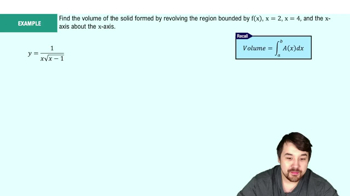
What is partial fraction decomposition used for in calculus?
Partial fraction decomposition is used to express a rational function as a sum of simpler fractions, making integration easier.
How do you set up partial fraction decomposition for a rational function with distinct linear factors in the denominator?
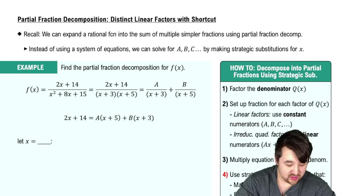
You write the function as a sum of constants over each distinct linear factor, such as A/(ax+b) + B/(cx+d).
What is the first step in partial fraction decomposition?
The first step is to factor the denominator of the rational function.
How do you solve for the unknown constants in partial fraction decomposition?
You multiply both sides by the common denominator and either use a system of equations or strategic substitutions for x to solve for the constants.
What shortcut can be used instead of solving a system of equations in partial fraction decomposition?
You can use strategic substitutions for x, choosing values that make one of the terms zero, to quickly solve for the constants.
What is the 'cover-up' or Heaviside method in partial fraction decomposition?
It is a shortcut where you substitute values for x to eliminate terms and solve for constants directly, often referred to as the cover-up or Heaviside method.
When integrating a rational function, why might partial fraction decomposition be necessary?
Partial fraction decomposition is necessary when other integration methods fail and the denominator can be factored, allowing the integral to be split into simpler parts.
How do you handle repeated linear factors in partial fraction decomposition?
For repeated linear factors, you include a separate term for each power up to the exponent, such as A/(ax+b) + B/(ax+b)^2 + ... + N/(ax+b)^n.
What is the setup for partial fraction decomposition when the denominator has a repeated linear factor like (x-1)^2?
You write terms for each power: A/(x-1) + B/(x-1)^2.
How do you handle irreducible quadratic factors in partial fraction decomposition?
For irreducible quadratic factors, the numerators become linear expressions, such as (Bx+C)/(ax^2+bx+c).
What is the form of partial fraction decomposition for a rational function with a distinct linear factor and an irreducible quadratic factor in the denominator?
You write A/(linear factor) + (Bx+C)/(quadratic factor).
What do you do if the rational function is improper (numerator degree ≥ denominator degree)?
You first perform polynomial division to make the function proper, then apply partial fraction decomposition.
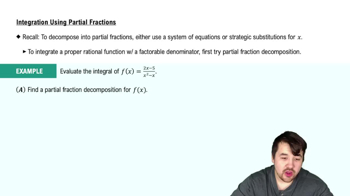
After decomposing a rational function into partial fractions, how do you integrate each term?
You integrate each term separately, often using basic integral rules such as ∫1/x dx = ln|x|.
Why do you need to include terms for each power when the denominator has a repeated irreducible quadratic factor?
Each power requires a separate term with a linear numerator, such as (Ax+B)/(quadratic)^1, (Cx+D)/(quadratic)^2, up to the highest power.
What is the main difference in the numerators when decomposing over irreducible quadratic factors compared to linear factors?
For irreducible quadratic factors, the numerators are linear expressions (e.g., Bx+C), while for linear factors, the numerators are constants.
 Back
Back
 08:01
08:01