Skip to main content
Calculus
My Course
Learn
Exam Prep
AI Tutor
Study Guides
Textbook Solutions
Flashcards
Explore
Try the app
My Course
Learn
Exam Prep
AI Tutor
Study Guides
Textbook Solutions
Flashcards
Explore
Try the app
Back
Partial Fractions definitions
You can tap to flip the card.
Partial Fraction Decomposition
You can tap to flip the card.
👆
Partial Fraction Decomposition
A technique for expressing a rational function as a sum of simpler fractions, making integration and algebraic manipulation more manageable.
Track progress
Control buttons has been changed to "navigation" mode.
1/15
Related flashcards
Related practice
Recommended videos
Partial Fractions quiz
Partial Fractions
15 Terms
Partial Fractions
12. Techniques of Integration
5 problems
Topic
Jonathan
Improper Integrals
12. Techniques of Integration
5 problems
Topic
Ernest
12. Techniques of Integration
3 topics
9 problems
Chapter
Ernest
Guided course
08:01
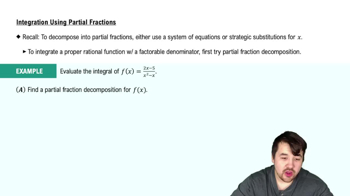
Integration Using Partial Fractions
Guided course
12:27
Partial Fraction Decomposition: Repeated Linear Factors Example 5
5
views
Guided course
07:24
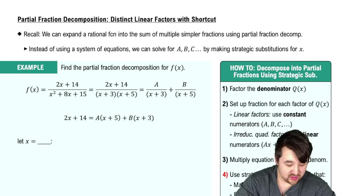
Partial Fraction Decomposition: Distinct Linear Factors with Shortcut
2
views
Terms in this set (15)
Hide definitions
Partial Fraction Decomposition
A technique for expressing a rational function as a sum of simpler fractions, making integration and algebraic manipulation more manageable.
Rational Function
An expression formed by dividing one polynomial by another, often requiring decomposition for integration.
Distinct Linear Factor
A denominator component of the form (ax + b) that appears only once and is used to set up separate simple fractions.
Repeated Linear Factor
A denominator component of the form (ax + b)^n, requiring a sum of fractions for each power from 1 to n.
Irreducible Quadratic Factor
A quadratic denominator, such as (ax^2 + bx + c), that cannot be factored further over the reals and needs a linear numerator in decomposition.
Numerator
The top part of a fraction, which may be a constant or a linear expression depending on the denominator's structure.
Denominator
The bottom part of a fraction, whose factorization determines the form of the partial fractions.
System of Equations
A set of simultaneous equations used to solve for unknown constants in the decomposition process.
Strategic Substitution
A shortcut method where specific values for the variable are chosen to simplify equations and quickly solve for constants.
Common Denominator
A shared multiple of all denominators, used to clear fractions and equate numerators during decomposition.
Improper Rational Function
A rational function where the numerator's degree is greater than or equal to the denominator's, requiring polynomial division before decomposition.
Cover-Up Method
A shortcut for finding constants in partial fractions by temporarily ignoring certain factors, also known as the Heaviside method.
Coefficient Comparison
A process of matching coefficients of like powers on both sides of an equation to form a system for solving unknowns.
Integration
The process of finding the antiderivative, often simplified by expressing complex rational functions as sums of basic fractions.
Polynomial Division
An initial step for improper rational functions, dividing the numerator by the denominator to simplify before decomposition.
 BackBack
 08:01
08:01