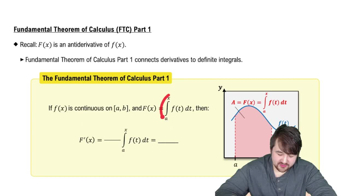
What does the Fundamental Theorem of Calculus Part One state about the relationship between derivatives and definite integrals?
It states that the derivative of the antiderivative of a continuous function equals the original function, or F'(x) = f(x).
What must be true about a function for the Fundamental Theorem of Calculus Part One to apply?
The function must be continuous on the interval [a, b].
How do you find the derivative of an integral with a variable upper bound using the Fundamental Theorem of Calculus Part One?
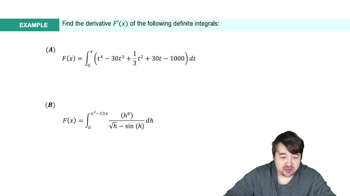
You replace the variable inside the integral with the upper bound variable and, if the upper bound is a function of x, multiply by its derivative (chain rule).
What is the result of taking the derivative of the integral from a to x of f(t) dt?
The result is f(x).
If the upper bound of the integral is x^2 instead of x, what additional step must you take?
You must multiply the result by the derivative of x^2, which is 2x.
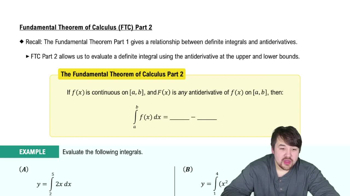
What does the Fundamental Theorem of Calculus Part Two allow you to do with definite integrals?
It allows you to evaluate a definite integral by finding the antiderivative and subtracting its value at the lower bound from its value at the upper bound.
How do you write the evaluation of a definite integral using the Fundamental Theorem of Calculus Part Two?
You write it as F(b) - F(a), where F is any antiderivative of f.
Why is the constant of integration (+C) not needed when evaluating definite integrals?
Because the constants cancel out when you subtract F(a) from F(b).
What is the geometric interpretation of a definite integral?
It represents the area under the curve of the function between the given bounds.
What rule do you use to find the antiderivative of a polynomial term like 2x?
You use the power rule: increase the exponent by one and divide by the new exponent.
When evaluating the definite integral of a sum or difference of functions, what can you do?
You can take the antiderivative of each term separately and then evaluate the result at the bounds.
What is the solution to the definite integral of 2x from 2 to 5?
The solution is 21.
If you have the definite integral from 1 to 4 of x^2 - 4x + 5 dx, what is the final answer after evaluating?
The final answer is 6.
What happens if you take the derivative of the antiderivative of a function?
You get back the original function.
What is the main idea to remember when using the Fundamental Theorem of Calculus Part One with a function of x as the upper bound?
Replace the variable inside the integral with the upper bound and multiply by the derivative of the upper bound (chain rule).
 Back
Back
 05:22
05:22