Skip to main content
Calculus
My Course
Learn
Exam Prep
AI Tutor
Study Guides
Textbook Solutions
Flashcards
Explore
Try the app
My Course
Learn
Exam Prep
AI Tutor
Study Guides
Textbook Solutions
Flashcards
Explore
Try the app
Back
Fundamental Theorem of Calculus definitions
You can tap to flip the card.
Definite Integral
You can tap to flip the card.
👆
Definite Integral
Represents the signed area under a curve between two bounds, calculated using antiderivatives and subtraction.
Track progress
Control buttons has been changed to "navigation" mode.
1/15
Related flashcards
Related practice
Recommended videos
Fundamental Theorem of Calculus quiz
Fundamental Theorem of Calculus
15 Terms
Fundamental Theorem of Calculus
8. Definite Integrals
5 problems
Topic
Ernest
Average Value of a Function
8. Definite Integrals
5 problems
Topic
Ernest
8. Definite Integrals - Part 1 of 2
5 topics
14 problems
Chapter
Ernest
8. Definite Integrals - Part 2 of 2
1 topic
3 problems
Chapter
Ernest
Guided course
05:22
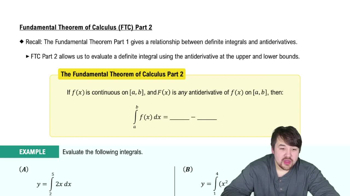
Fundamental Theorem of Calculus Part 2
2
views
Guided course
06:11
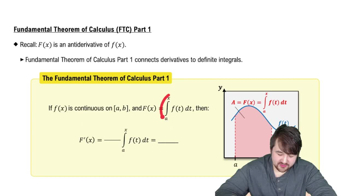
Fundamental Theorem of Calculus Part 1
1
views
Guided course
03:25
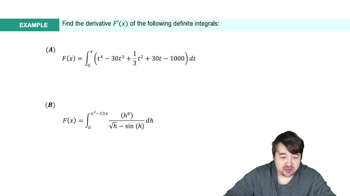
Fundamental Theorem of Calculus Part 1 Example1
3
views
Terms in this set (15)
Hide definitions
Definite Integral
Represents the signed area under a curve between two bounds, calculated using antiderivatives and subtraction.
Antiderivative
A function whose derivative returns the original function, used to evaluate definite integrals efficiently.
Continuity
A property ensuring a function has no breaks or jumps on an interval, required for applying the theorem.
Interval
A set of real numbers between two endpoints, often serving as the bounds for integration.
Upper Bound
The highest value in the limits of integration, where the antiderivative is evaluated and subtracted.
Lower Bound
The lowest value in the limits of integration, used as the starting point for evaluating the antiderivative.
Chain Rule
A differentiation technique applied when the upper bound of an integral is a function of the variable.
Power Rule
A method for finding antiderivatives or derivatives involving exponents, crucial for integration steps.
Variable Substitution
The process of replacing the variable inside an integral with the upper bound during differentiation.
Signed Area
The net area under a curve, accounting for regions above and below the x-axis, found using definite integrals.
Plus C
The constant of integration, omitted in definite integrals since it cancels during subtraction of bounds.
Bar Notation
A vertical line indicating evaluation of an antiderivative at the upper and lower bounds.
Function of x
An expression where the variable x determines the output, often used as the upper bound in integrals.
Derivative
A measure of how a function changes as its input changes, central to connecting integrals and antiderivatives.
Cancellation
The phenomenon where differentiation and integration undo each other, yielding the original function.
 BackBack
 05:22
05:22