
Ch.12 - Parametric and Polar Curves
Briggs - Calculus: Early Transcendentals 3rd Edition
Briggs3rd EditionCalculus: Early TranscendentalsISBN: 9780136847243Not the one you use?Change textbook
Chapter 12, Problem 12.3.11

11–20. Slopes of tangent lines Find the slope of the line tangent to the following polar curves at the given points.


r = 1 - sin θ; (1/2, π/6)

Verified step by step guidance
1
Recall that for a polar curve given by \(r = f(\theta)\), the slope of the tangent line \(\frac{dy}{dx}\) can be found using the formulas for \(x\) and \(y\) in terms of \(r\) and \(\theta\): \(x = r \cos \theta\) and \(y = r \sin \theta\).
Express \(x\) and \(y\) as functions of \(\theta\): \(x(\theta) = r(\theta) \cos \theta\) and \(y(\theta) = r(\theta) \sin \theta\). For the given curve, \(r = 1 - \sin \theta\), so substitute this into \(x(\theta)\) and \(y(\theta)\).
Find the derivatives \(\frac{dx}{d\theta}\) and \(\frac{dy}{d\theta}\) by applying the product rule: \(\frac{d}{d\theta}[r(\theta) \cos \theta]\) and \(\frac{d}{d\theta}[r(\theta) \sin \theta]\). Remember to differentiate both \(r(\theta)\) and the trigonometric functions.
Calculate the slope of the tangent line using the formula \(\frac{dy}{dx} = \frac{\frac{dy}{d\theta}}{\frac{dx}{d\theta}}\). This gives the slope in terms of \(\theta\).
Evaluate \(\frac{dy}{dx}\) at the given point \(\theta = \frac{\pi}{6}\) to find the slope of the tangent line at that point.

Verified video answer for a similar problem:

This video solution was recommended by our tutors as helpful for the problem above.
Video duration:
4m

Key Concepts

Here are the essential concepts you must grasp in order to answer the question correctly.

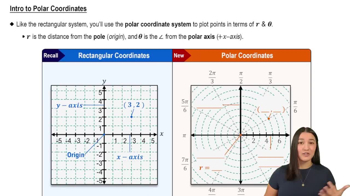
Polar Coordinates and Polar Curves

Polar coordinates represent points using a radius and an angle (r, θ) instead of Cartesian coordinates (x, y). Polar curves are equations expressed as r = f(θ), describing how the radius changes with the angle. Understanding this system is essential for interpreting the given curve and point.
Recommended video:
05:32
Intro to Polar Coordinates

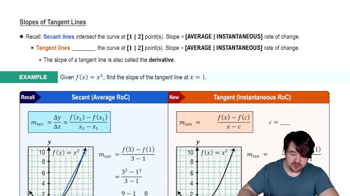
Slope of Tangent Line in Polar Coordinates

The slope of the tangent line to a polar curve at a point is found by converting the curve to parametric form (x = r cos θ, y = r sin θ) and then computing dy/dx = (dy/dθ) / (dx/dθ). This method links polar derivatives to Cartesian slopes.
Recommended video:
Guided course
05:13
Slopes of Tangent Lines

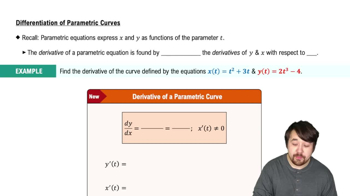
Differentiation of Parametric Functions

To find dy/dx for parametric equations, differentiate x(θ) and y(θ) with respect to θ separately, then divide dy/dθ by dx/dθ. This technique is crucial for determining the slope of the tangent line to curves defined parametrically, such as polar curves.
Recommended video:
Guided course
06:49
Differentiation of Parametric Curves
Related Practice
Textbook Question

13–30. Graphing conic sections Determine whether the following equations describe a parabola, an ellipse, or a hyperbola, and then sketch a graph of the curve. For each parabola, specify the location of the focus and the equation of the directrix; for each ellipse, label the coordinates of the vertices and foci, and find the lengths of the major and minor axes; for each hyperbola, label the coordinates of the vertices and foci, and find the equations of the asymptotes.


x² = 12y

Textbook Question

39–50. Equations of ellipses and hyperbolas Find an equation of the following ellipses and hyperbolas, assuming the center is at the origin. 

An ellipse with vertices (±5, 0), passing through the point (4, 3/5)

Textbook Question

37–52. Curves to parametric equations Find parametric equations for the following curves. Include an interval for the parameter values. Answers are not unique.


A circle centered at the origin with radius 4, generated counterclockwise

1
views
Textbook Question

Circles in general Show that the polar equation

r² - 2r r₀ cos(θ - θ₀) = R² - r₀²

describes a circle of radius R whose center has polar coordinates (r₀, θ₀)

Textbook Question

45–60. Areas of regions Find the area of the following regions.


The region inside the outer loop but outside the inner loop of the limaçon r = 3 - 6 sin θ

Textbook Question

15–30. Working with parametric equations Consider the following parametric equations.

a. Eliminate the parameter to obtain an equation in x and y.

b. Describe the curve and indicate the positive orientation.


x = cos t, y = sin² t; 0 ≤ t ≤ π

8
views