Ch. 7 - Transcendental Functions
Hass - Thomas' Calculus 15th Edition
Hass15th EditionThomas' CalculusISBN: 9780137616077Not the one you use?Change textbook
Chapter 7, Problem 7.3.154a

154. The linearization of log₃x
a. Find the linearization of
f(x) = log₃xatx = 3.
Then round its coefficients to two decimal places.

Verified step by step guidance
1
Identify the function to linearize: \( f(x) = \log_3 x \). The goal is to find the linear approximation of \( f(x) \) near \( x = 3 \).
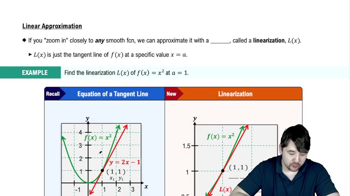
Recall the formula for linearization (or the linear approximation) of a function \( f(x) \) at \( x = a \): \[ L(x) = f(a) + f'(a)(x - a) \] where \( f'(a) \) is the derivative of \( f(x) \) evaluated at \( x = a \).
Calculate \( f(3) \): Since \( f(x) = \log_3 x \), use the change of base formula to express it in terms of natural logarithms: \[ f(3) = \log_3 3 = 1 \] because \( \log_b b = 1 \) for any base \( b > 0 \).
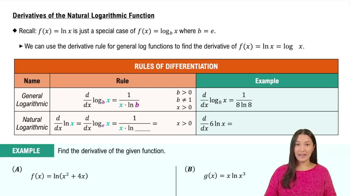
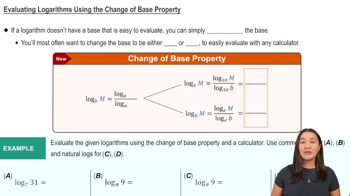
Find the derivative \( f'(x) \) of \( f(x) = \log_3 x \). Using the change of base formula: \[ f(x) = \frac{\ln x}{\ln 3} \] so \[ f'(x) = \frac{1}{x \ln 3} \]. Evaluate this at \( x = 3 \): \[ f'(3) = \frac{1}{3 \ln 3} \].
Write the linearization formula substituting \( a = 3 \), \( f(3) = 1 \), and \( f'(3) = \frac{1}{3 \ln 3} \): \[ L(x) = 1 + \frac{1}{3 \ln 3} (x - 3) \]. Finally, round the coefficients \( 1 \) and \( \frac{1}{3 \ln 3} \) to two decimal places to complete the linearization.

Verified video answer for a similar problem:

This video solution was recommended by our tutors as helpful for the problem above.
Video duration:
4m
Was this helpful?

Key Concepts

Here are the essential concepts you must grasp in order to answer the question correctly.

Linearization of a Function

Linearization approximates a function near a point using the tangent line at that point. It is given by L(x) = f(a) + f'(a)(x - a), where a is the point of tangency. This simplifies complex functions to linear ones for easier estimation near a.
Recommended video:
07:17
Linearization

Derivative of Logarithmic Functions

The derivative of log base b of x, log_b(x), is 1 / (x ln(b)). This formula is essential to find the slope of the tangent line when linearizing logarithmic functions with arbitrary bases.
Recommended video:
05:18
Derivative of the Natural Logarithmic Function

Change of Base and Evaluation at a Point

Evaluating log₃(x) and its derivative at x = 3 requires substituting x = 3 into the function and derivative. Using the natural logarithm for calculations ensures accuracy, and rounding coefficients to two decimals finalizes the linear approximation.
Recommended video:
05:36
Change of Base Property