Ch. 10 - Infinite Sequences and Series
Hass - Thomas' Calculus 15th Edition
Hass15th EditionThomas' CalculusISBN: 9780137616077Not the one you use?Change textbook
Chapter 10, Problem 10.6.52

Error Estimation
In Exercises 49–52, estimate the magnitude of the error involved in using the sum of the first four terms to approximate the sum of the entire series.
1 / (1 + t) = ∑ (from n = 0 to ∞) [(-1)ⁿ tⁿ],0 < t < 1

Verified step by step guidance
1
Recognize that the given series is the Taylor (or Maclaurin) series expansion of the function \(\frac{1}{1+t}\) around \(t=0\), expressed as \(\sum_{n=0}^\infty (-1)^n t^n\) for \(0 < t < 1\).
Since the series is an alternating series with terms decreasing in magnitude, the Alternating Series Estimation Theorem applies. This theorem states that the magnitude of the error when approximating the sum by the first \(N\) terms is less than or equal to the magnitude of the first omitted term.
Identify the first four terms as those with indices \(n=0,1,2,3\). The next term, which is the first omitted term, corresponds to \(n=4\) and has the form \((-1)^4 t^4 = t^4\).
Therefore, the magnitude of the error in approximating the sum by the first four terms is at most \(|t^4|\), which simplifies to \(t^4\) since \(t > 0\).
To estimate the error for a specific value of \(t\) in the interval \((0,1)\), substitute that value into \(t^4\) to find the upper bound on the error magnitude.

Verified video answer for a similar problem:

This video solution was recommended by our tutors as helpful for the problem above.
Video duration:
1m
Was this helpful?

Key Concepts

Here are the essential concepts you must grasp in order to answer the question correctly.

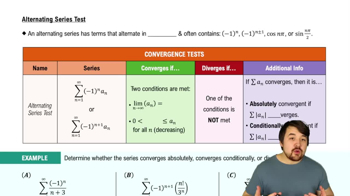
Alternating Series and Their Convergence

An alternating series is a series whose terms alternate in sign. For the series 1/(1+t) expanded as ∑ (-1)^n t^n, the terms decrease in magnitude and approach zero when 0 < t < 1, ensuring convergence. Understanding this helps justify using partial sums to approximate the series.
Recommended video:
10:54
Alternating Series Test

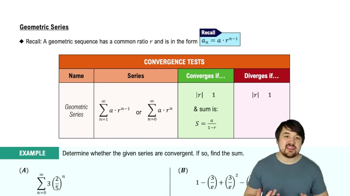
Error Estimation in Alternating Series

The error when approximating an alternating series by its first n terms is less than or equal to the absolute value of the (n+1)th term. This property allows us to bound the magnitude of the error simply by evaluating the next term in the series.
Recommended video:
06:00
Geometric Series

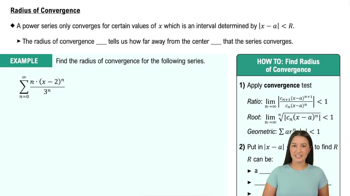
Power Series Representation and Radius of Convergence

A power series expresses a function as an infinite sum of powers of a variable. The radius of convergence defines the interval where the series converges to the function. For 1/(1+t), the series converges for |t| < 1, which is crucial for valid error estimation.
Recommended video:
07:36
Radius of Convergence