
Textbook Question
In Exercises 57–82, use any method to determine whether the series converges or diverges. Give reasons for your answer.
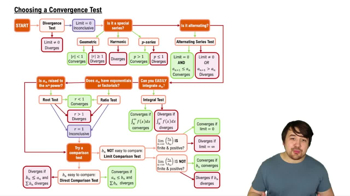
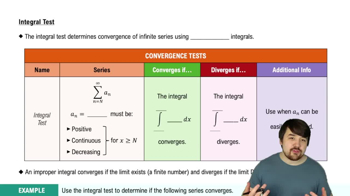
∑ (from n = 1 to ∞) [3ⁿ / n³]

 Verified step by step guidance
 07:51
07:51
 07:25
07:25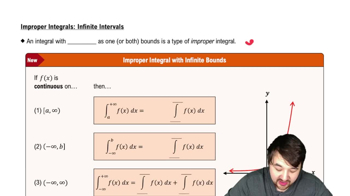 11:11
11:11In Exercises 57–82, use any method to determine whether the series converges or diverges. Give reasons for your answer.
∑ (from n = 1 to ∞) [3ⁿ / n³]
Error Estimation
In Exercises 49–52, estimate the magnitude of the error involved in using the sum of the first four terms to approximate the sum of the entire series.
1 / (1 + t) = ∑ (from n = 0 to ∞) [(-1)ⁿ tⁿ],0 < t < 1
Limit Comparison Test
In Exercises 9–16, use the Limit Comparison Test to determine if each series converges or diverges.
∑ (from n=2 to ∞) 1 / ln n
(Hint: Limit Comparison with ∑ (from n=2 to ∞) (1/n))
Telescoping Series
In Exercises 39–44, find a formula for the nth partial sum of the series and use it to determine if the series converges or diverges. If a series converges, find its sum.
∑ (from n = 1 to ∞) [ (1/n) − (1/(n + 1)) ]
Intervals of Convergence
In Exercises 1–36, (a) find the series’ radius and interval of convergence. For what values of x does the series converge (b) absolutely, (c) conditionally?
∑ (from n = 0 to ∞) (2x)ⁿ
Are there any values of x for which ∑ (from n=1 to ∞) (1 / nˣ) converges? Give reasons for your answer.