
Ch. 3 - Derivatives
Hass - Thomas' Calculus 15th Edition
Hass15th EditionThomas' CalculusISBN: 9780137616077Not the one you use?Change textbook
Chapter 3, Problem 3.3.56

For Exercises 55 and 56, evaluate each limit by first converting each to a derivative at a particular x-value.


lim (x → −1) (x²/⁹ − 1) / (x + 1)

Verified step by step guidance
1
Recognize that the given limit can be evaluated using L'Hôpital's Rule, which applies to limits of the form 0/0 or ∞/∞. However, first, we need to express the limit in a form that resembles the definition of a derivative.
Notice that the expression (x²/9 - 1)/(x + 1) can be rewritten to resemble the difference quotient, which is the form used in the definition of a derivative. Specifically, we want to express it as f(x) - f(a) / (x - a) where a is a specific x-value.
Identify the function f(x) = x²/9 and the point a = -1. The expression then becomes (f(x) - f(-1)) / (x - (-1)).
Calculate f(-1) by substituting x = -1 into the function f(x) = x²/9. This gives f(-1) = (-1)²/9 = 1/9.
Now, the limit expression becomes ((x²/9) - 1/9) / (x + 1), which is equivalent to the derivative of f(x) = x²/9 at x = -1. Evaluate this derivative using the power rule, which states that the derivative of x^n is n*x^(n-1).

Verified video answer for a similar problem:

This video solution was recommended by our tutors as helpful for the problem above.
Video duration:
4m
Was this helpful?

Key Concepts

Here are the essential concepts you must grasp in order to answer the question correctly.

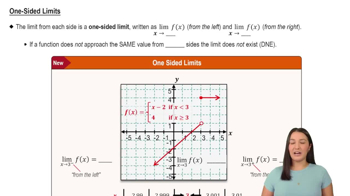
Limit

A limit in calculus is the value that a function approaches as the input approaches a certain point. Understanding limits is crucial for evaluating the behavior of functions at specific points, especially where direct substitution might lead to indeterminate forms like 0/0. Limits are foundational for defining derivatives and integrals.
Recommended video:
05:50
One-Sided Limits

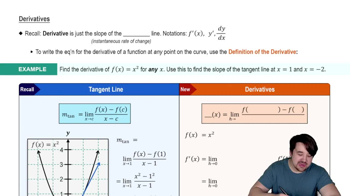
Derivative

A derivative represents the rate of change of a function with respect to a variable. It is the limit of the average rate of change as the interval approaches zero. Derivatives are used to find slopes of tangent lines and are essential for solving problems involving instantaneous rates of change, optimization, and motion.
Recommended video:
05:44
Derivatives

L'Hôpital's Rule

L'Hôpital's Rule is a method for evaluating limits of indeterminate forms, such as 0/0 or ∞/∞. It states that if the limit of a quotient results in an indeterminate form, the limit can be found by taking the derivative of the numerator and the derivative of the denominator separately, then evaluating the limit of their quotient. This rule simplifies complex limit problems.
Recommended video: