
Slopes on the graph of the tangent function Graph y = tan x and its derivative together on (−π/2, π/2). Does the graph of the tangent function appear to have a smallest slope? A largest slope? Is the slope ever negative? Give reasons for your answers.
Ch. 3 - Derivatives
Chapter 3, Problem 3.7.29
In Exercises 29 and 30, find the slope of the curve at the given points.
y² + x² = y⁴ – 2x at (–2,1) and (–2,–1)
Verified step by step guidance1
First, recognize that the given equation y² + x² = y⁴ – 2x is an implicit function. To find the slope of the curve at a given point, we need to differentiate both sides of the equation with respect to x using implicit differentiation.
Differentiate the left side of the equation: The derivative of y² with respect to x is 2y(dy/dx) and the derivative of x² is 2x.
Differentiate the right side of the equation: The derivative of y⁴ with respect to x is 4y³(dy/dx) and the derivative of -2x is -2.
Set up the equation from the derivatives: 2y(dy/dx) + 2x = 4y³(dy/dx) - 2. Rearrange this equation to solve for dy/dx, which represents the slope of the curve.
Substitute the given points (-2,1) and (-2,-1) into the equation for dy/dx to find the slope at each point. This involves substituting x = -2 and y = 1 for the first point, and x = -2 and y = -1 for the second point, then solving for dy/dx in each case.

Verified video answer for a similar problem:
This video solution was recommended by our tutors as helpful for the problem above.
Video duration:
3mWas this helpful?
Key Concepts
Here are the essential concepts you must grasp in order to answer the question correctly.
Implicit Differentiation
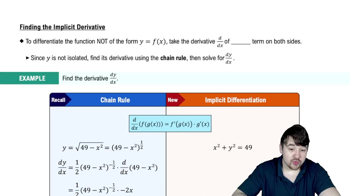
Implicit differentiation is a technique used to find the derivative of functions that are not explicitly solved for one variable in terms of another. In equations like y² + x² = y⁴ – 2x, where y is not isolated, implicit differentiation allows us to differentiate both sides with respect to x, treating y as a function of x, and applying the chain rule where necessary.
Recommended video:
Finding The Implicit Derivative
Slope of a Curve
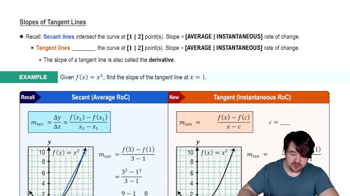
The slope of a curve at a given point is the derivative of the function at that point, representing the rate of change of the function with respect to x. For a curve defined implicitly, the slope can be found by differentiating the equation and solving for dy/dx, which gives the slope of the tangent line to the curve at the specified point.
Recommended video:
Slopes of Tangent Lines
Substitution of Points
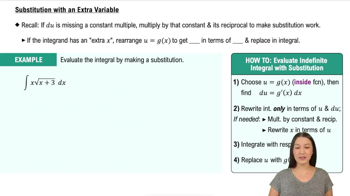
Substitution involves plugging specific coordinates into the derivative to find the slope at those points. After finding the general expression for dy/dx using implicit differentiation, substitute the given points, such as (–2,1) and (–2,–1), into this expression to calculate the slope of the curve at each point, ensuring the points satisfy the original equation.
Recommended video:
Substitution With an Extra Variable
Related Practice
Textbook Question
Textbook Question
Differentiating Implicitly
Use implicit differentiation to find dy/dx in Exercises 1–14.
x²(x – y)² = x² – y²
Textbook Question
Derivatives in Differential Form
In Exercises 17–28, find dy.
y = 3 csc(1 − 2√x)
Textbook Question
Second Derivatives
In Exercises 19–26, use implicit differentiation to find dy/dx and then d²y/dx². Write the solutions in terms of x and y only.
y² = x² + 2x
Textbook Question
In Exercises 65 and 66, find the derivative using the definition.
ƒ(t) = 1 .
2t + 1
Textbook Question
For Exercises 55 and 56, evaluate each limit by first converting each to a derivative at a particular x-value.
lim (x → −1) (x²/⁹ − 1) / (x + 1)
