Ch. 7 - Transcendental Functions
Hass - Thomas' Calculus 15th Edition
Hass15th EditionThomas' CalculusISBN: 9780137616077Not the one you use?Change textbook
Chapter 7, Problem 7.PE.113

113. The function f(x) = e^x + x, being differentiable and one-to-one, has a differentiable inverse f^(-1)(x). Find the value of df^(-1)/dx at the point f (ln 2).

Verified step by step guidance
1
Identify the given function: \(f(x) = e^{x} + x\). We are asked to find the derivative of the inverse function \(f^{-1}(x)\) at the point \(x = f(\ln 2)\).
Recall the formula for the derivative of the inverse function: if \(y = f(x)\) and \(f\) is invertible and differentiable, then \(\frac{d}{dx} f^{-1}(x) = \frac{1}{f'(f^{-1}(x))}\).
Calculate \(f(\ln 2)\) by substituting \(x = \ln 2\) into the original function: \(f(\ln 2) = e^{\ln 2} + \ln 2\).
Find the derivative of the original function: \(f'(x) = \frac{d}{dx}(e^{x} + x) = e^{x} + 1\).
Evaluate \(f'(x)\) at \(x = \ln 2\) to get \(f'(\ln 2) = e^{\ln 2} + 1\). Then, use the inverse derivative formula to write \(\frac{d}{dx} f^{-1}(f(\ln 2)) = \frac{1}{f'(\ln 2)}\).

Verified video answer for a similar problem:

This video solution was recommended by our tutors as helpful for the problem above.
Video duration:
3m
Was this helpful?

Key Concepts

Here are the essential concepts you must grasp in order to answer the question correctly.

Inverse Function and Its Differentiability

If a function is one-to-one and differentiable with a nonzero derivative, its inverse exists and is differentiable. The inverse function reverses the roles of inputs and outputs, allowing us to express x in terms of y = f(x). Understanding this ensures we can apply differentiation rules to the inverse.
Recommended video:
06:35
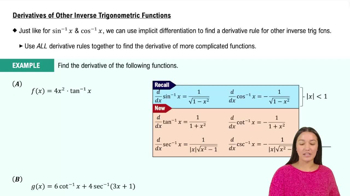
Derivatives of Other Inverse Trigonometric Functions

Derivative of the Inverse Function

The derivative of the inverse function at a point y = f(x) is given by (df^(-1)/dx)(y) = 1 / (df/dx)(x). This formula relates the slope of the inverse function to the slope of the original function, enabling us to find the inverse derivative by evaluating the original function's derivative at the corresponding x.
Recommended video:
06:35
Derivatives of Other Inverse Trigonometric Functions

Evaluating the Function and Its Derivative at a Specific Point

To find the derivative of the inverse at f(ln 2), we first compute f(ln 2) and then find f'(ln 2). This step is crucial because the inverse derivative depends on the original function's derivative at the point where the inverse is evaluated, linking the values precisely.
Recommended video:
4:26
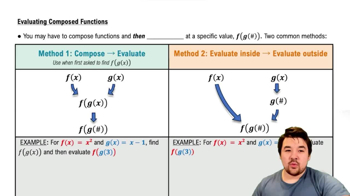
Evaluating Composed Functions