Ch. 7 - Transcendental Functions
Hass - Thomas' Calculus 15th Edition
Hass15th EditionThomas' CalculusISBN: 9780137616077Not the one you use?Change textbook
Chapter 7, Problem 7.PE.110f

110. Does f grow faster, slower, or at the same rate as g as x→∞? Give reasons for your answers.
f. f(x) = sech(x), g(x) = e^(-x)

Verified step by step guidance
1
Recall the definitions of the functions: \(f(x) = \text{sech}(x)\) and \(g(x) = e^{-x}\). The hyperbolic secant function is defined as \(\text{sech}(x) = \frac{2}{e^{x} + e^{-x}}\).
Analyze the behavior of \(f(x)\) as \(x \to \infty\). Since \(e^{x}\) grows very large, the term \(e^{x} + e^{-x}\) is dominated by \(e^{x}\), so \(\text{sech}(x) \approx \frac{2}{e^{x}} = 2e^{-x}\) for large \(x\).
Compare this approximation of \(f(x)\) to \(g(x) = e^{-x}\). Notice that \(f(x)\) behaves like \(2e^{-x}\), which is just a constant multiple of \(g(x)\) as \(x \to \infty\).
Since \(f(x)\) and \(g(x)\) differ only by a constant factor in their dominant terms for large \(x\), they decay at the same exponential rate as \(x \to \infty\).
Conclude that \(f\) and \(g\) grow (or decay) at the same rate as \(x \to \infty\) because their leading terms have the same exponential order.

Verified video answer for a similar problem:

This video solution was recommended by our tutors as helpful for the problem above.
Video duration:
2m
Was this helpful?

Key Concepts

Here are the essential concepts you must grasp in order to answer the question correctly.

Asymptotic Behavior of Functions

Asymptotic behavior describes how functions behave as the input approaches a limit, often infinity. Understanding this helps compare growth rates by analyzing limits of ratios or differences as x→∞, revealing which function dominates or if they grow at similar rates.
Recommended video:
5:50
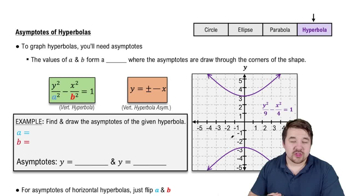
Asymptotes of Hyperbolas

Hyperbolic Secant Function (sech)

The hyperbolic secant, sech(x), is defined as 1/cosh(x), where cosh(x) = (e^x + e^{-x})/2. As x→∞, cosh(x) grows exponentially, so sech(x) approaches zero exponentially, behaving similarly to e^{-x} but with a specific constant factor.
Recommended video:
6:22
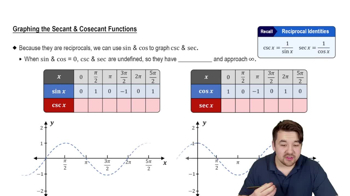
Graphs of Secant and Cosecant Functions

Exponential Decay and Comparison

Exponential decay functions like e^{-x} decrease rapidly as x→∞. Comparing f(x) = sech(x) to g(x) = e^{-x} involves examining their rates of decay by considering limits of their ratio, which determines if one decays faster, slower, or at the same rate.
Recommended video:
09:29
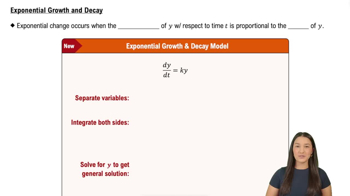
Exponential Growth & Decay