Ch. 8 - Integration Techniques
Briggs - Calculus: Early Transcendentals 3rd Edition
Briggs3rd EditionCalculus: Early TranscendentalsISBN: 9780136847243Not the one you use?Change textbook
Chapter 8, Problem 8.7.34

7–40. Table look-up integrals Use a table of integrals to evaluate the following indefinite integrals. Some of the integrals require preliminary work, such as completing the square or changing variables, before they can be found in a table.
34. ∫ dx / (x(x¹⁰ + 1))

Verified step by step guidance
1
Step 1: Recognize that the integral ∫ dx / (x(x¹⁰ + 1)) involves a rational function. To simplify, consider using substitution or breaking the integral into parts that match entries in a table of integrals.
Step 2: Observe that the denominator contains x and (x¹⁰ + 1). Let u = x¹⁰ + 1, which simplifies the integral. Compute du/dx = 10x⁹, so dx = du / (10x⁹). Substitute this into the integral.
Step 3: After substitution, the integral becomes ∫ dx / (x(x¹⁰ + 1)) = ∫ du / (10x⁹ * u). Notice that x⁹ can be expressed in terms of u using the substitution u = x¹⁰ + 1, which implies x¹⁰ = u - 1 and x⁹ = (u - 1)^(9/10).
Step 4: Rewrite the integral in terms of u and simplify further. This step may involve algebraic manipulation to match a form found in a table of integrals.
Step 5: Use the table of integrals to find the corresponding entry for the simplified integral. Apply the result from the table and back-substitute u = x¹⁰ + 1 to express the solution in terms of x.

Verified video answer for a similar problem:

This video solution was recommended by our tutors as helpful for the problem above.
Video duration:
5m
Was this helpful?

Key Concepts

Here are the essential concepts you must grasp in order to answer the question correctly.

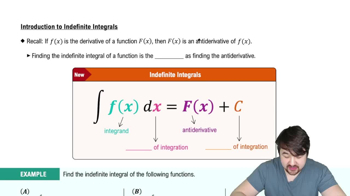
Indefinite Integrals

Indefinite integrals represent a family of functions whose derivative is the integrand. They are expressed without limits and include a constant of integration, typically denoted as 'C'. Understanding how to evaluate indefinite integrals is crucial for solving problems involving antiderivatives and finding general solutions to differential equations.
Recommended video:
05:04
Introduction to Indefinite Integrals

Integration Techniques

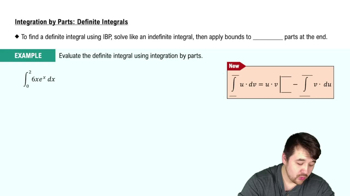
Various techniques are employed to evaluate integrals, especially when they cannot be solved directly. Common methods include substitution, integration by parts, and partial fraction decomposition. In this case, recognizing the need for preliminary work, such as completing the square or changing variables, is essential for simplifying the integral before using a table of integrals.
Recommended video:
06:18
Integration by Parts for Definite Integrals

Tables of Integrals

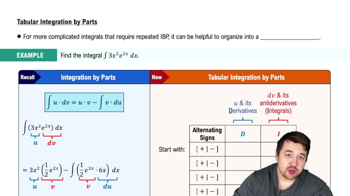
Tables of integrals provide a collection of standard integrals and their solutions, which can significantly simplify the process of integration. These tables often include integrals of common functions and forms, allowing students to quickly find the antiderivative of a given function. Familiarity with these tables and knowing when to apply them is vital for efficiently solving complex integrals.
Recommended video:
08:09
Tabular Integration by Parts