Ch. 8 - Integration Techniques
Briggs - Calculus: Early Transcendentals 3rd Edition
Briggs3rd EditionCalculus: Early TranscendentalsISBN: 9780136847243Not the one you use?Change textbook
Chapter 8, Problem 8.2.79

79. Tabular integration extended Refer to Exercise 77.
a. The following table shows the method of tabular integration applied to
∫ eˣ cos x dx.
Table showing functions and derivatives of f and integrals of g with arrows illustrating tabular integration steps.
Use the table to express ∫ eˣ cos x dx in terms of the sum of functions and an indefinite integral.
b. Solve the equation in part (a) for ∫ eʳ cos z dz.
c. Evaluate ∫ e⁻ᶻ sin 3z dz by applying the idea from parts (a) and (b).

Verified step by step guidance
1
Identify the functions from the table: let \( f(x) = e^x \) and \( g(x) = \cos x \). The table shows derivatives of \( f \) and integrals of \( g \) along with signs for tabular integration.
Use the tabular integration method to write \( \int e^x \cos x \, dx \) as the sum of products of \( f \) and integrals of \( g \) with alternating signs, plus the remaining integral. From the table, this gives: \[ \int e^x \cos x \, dx = + e^x \sin x - e^x (-\cos x) + \int e^x (-\cos x) \, dx \]
Simplify the expression inside the integral and the sum of functions: \[ \int e^x \cos x \, dx = e^x \sin x + e^x \cos x - \int e^x \cos x \, dx \]
Recognize that the integral \( \int e^x \cos x \, dx \) appears on both sides of the equation. To solve for it, add \( \int e^x \cos x \, dx \) to both sides to isolate the integral term.
Divide both sides of the resulting equation by 2 to solve explicitly for \( \int e^x \cos x \, dx \). This gives the integral in terms of elementary functions without any remaining integral.

Verified video answer for a similar problem:

This video solution was recommended by our tutors as helpful for the problem above.
Video duration:
7m
Was this helpful?

Key Concepts

Here are the essential concepts you must grasp in order to answer the question correctly.

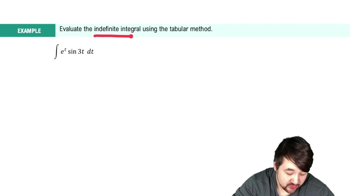
Tabular Integration Method

Tabular integration is a streamlined technique for repeated integration by parts, especially useful when differentiating one function repeatedly leads to a simple pattern. It involves creating a table of derivatives of one function and integrals of another, then combining these with alternating signs to find the integral efficiently.
Recommended video:
09:15
Tabular Integration by Parts Example 6

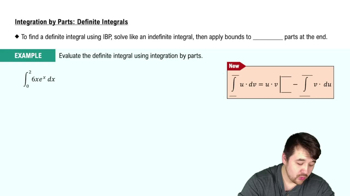
Integration by Parts

Integration by parts is a fundamental technique based on the product rule for differentiation. It transforms the integral of a product of functions into simpler integrals, using the formula ∫u dv = uv - ∫v du. This method is essential for integrals involving products of exponential, trigonometric, or polynomial functions.
Recommended video:
06:18
Integration by Parts for Definite Integrals

Solving Integral Equations Involving the Same Integral

Sometimes, applying integration by parts leads to an equation containing the original integral on both sides. Solving such equations involves algebraic manipulation to isolate the integral, allowing evaluation of integrals like ∫eˣ cos x dx, which recur during the integration process.
Recommended video:
07:01
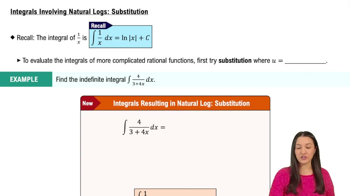
Integrals Involving Natural Logs: Substitution