
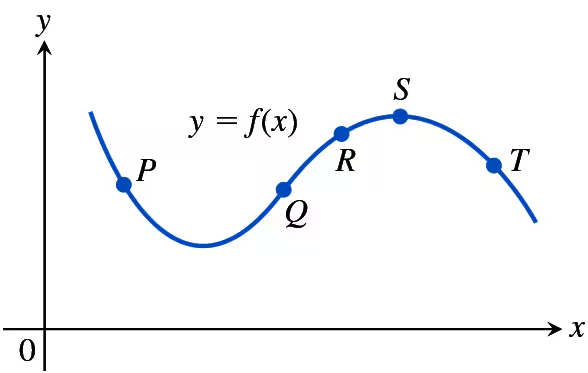
Each of Exercises 67–88 gives the first derivative of a continuous function y=f(x). Find y'' and then use Steps 2–4 of the graphing procedure described in this section to sketch the general shape of the graph of f.
85. y' = x^(-2/3) (x - 1)
Verified step by step guidance
Each of Exercises 67–88 gives the first derivative of a continuous function y=f(x). Find y'' and then use Steps 2–4 of the graphing procedure described in this section to sketch the general shape of the graph of f.
85. y' = x^(-2/3) (x - 1)
Finding Indefinite Integrals
In Exercises 17–56, find the most general antiderivative or indefinite integral. You may need to try a solution and then adjust your guess. Check your answers by differentiation.
∫(1/x² − x² − 1/3) dx
35. Determine the dimensions of the rectangle of largest area that can be inscribed in the right triangle shown in the accompanying figure.
Finding Critical Points
In Exercises 41–50, determine all critical points and all domain endpoints for each function.
f(x) = x(4 − x)³
Estimate the open intervals on which the function y = ƒ(𝓍) is
a. increasing.
b. decreasing.
c. Use the given graph of ƒ' to indicate where any local extreme
values of the function occur, and whether each extreme
is a relative maximum or minimum.
<IMAGE>
32. Answer Exercise 31 if one piece is bent into a square and the other into a circle.