Ch. 1 - Functions
Hass - Thomas' Calculus 15th Edition
Hass15th EditionThomas' CalculusISBN: 9780137616077Not the one you use?Change textbook
Chapter 1, Problem 1.36

In Exercises 35 and 36, find the (a) domain and (b) range.


𝔂 = { -x - 2, -2 ≀ x ≀ - 1
{ x, -1 < x ≀ 1
{ -x + 2, 1 < x ≀ 2

Verified step by step guidance
1
Step 1: Identify the piecewise function and its components. The function is defined as: y = -x - 2 for -2 ≀ x ≀ -1, y = x for -1 < x ≀ 1, and y = -x + 2 for 1 < x ≀ 2.
Step 2: Determine the domain of the function. The domain is the set of all x-values for which the function is defined. Here, the domain is the union of the intervals: [-2, -1], (-1, 1], and (1, 2].
Step 3: Analyze each piece of the function to find the range. For y = -x - 2, as x goes from -2 to -1, calculate the corresponding y-values. For y = x, as x goes from -1 to 1, calculate the y-values. For y = -x + 2, as x goes from 1 to 2, calculate the y-values.
Step 4: Combine the ranges from each piece to find the overall range of the function. Consider the y-values obtained from each interval and ensure there are no gaps.
Step 5: Verify the continuity and endpoints of the function. Check the values at the boundaries of each interval to ensure they are included in the range, and confirm that the function transitions smoothly between pieces where applicable.

Verified video answer for a similar problem:

This video solution was recommended by our tutors as helpful for the problem above.
Video duration:
7m
Was this helpful?

Key Concepts

Here are the essential concepts you must grasp in order to answer the question correctly.

Domain

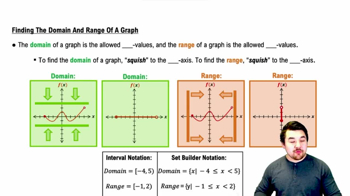
The domain of a function refers to the set of all possible input values (x-values) for which the function is defined. In this case, the function is piecewise defined, meaning it has different expressions for different intervals of x. To find the domain, we need to identify the intervals specified in the piecewise function and combine them to determine the overall set of x-values.
Recommended video:
5:10
Finding the Domain and Range of a Graph

Range

The range of a function is the set of all possible output values (y-values) that the function can produce based on its domain. For piecewise functions, we must evaluate each piece separately to find the corresponding y-values and then combine these results to determine the overall range. This often involves calculating the function's values at the endpoints of the intervals and any critical points within them.
Recommended video:
5:10
Finding the Domain and Range of a Graph

Piecewise Function

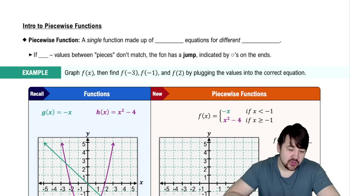
A piecewise function is defined by different expressions over different intervals of its domain. Each piece of the function applies to a specific range of x-values, and understanding how to analyze each segment is crucial for determining the overall behavior of the function. In this question, the function is defined in three segments, each with its own formula and domain restrictions.
Recommended video:
05:36
Piecewise Functions
Related Practice
Textbook Question

In Exercises 5–8, determine whether the graph of the function is symmetric about the 𝔂-axis, the origin, or neither.


𝔂 = xΒ²/⁡

1
views
Textbook Question

Shifting Graphs


Exercises 27–36 tell how many units and in what directions the graphs of the given equations are to be shifted. Give an equation for the shifted graph. Then sketch the original and shifted graphs together, labeling each graph with its equation.


y = βˆ’βˆšx Right 3

Textbook Question

Use graphing software to graph the functions specified in Exercises 31–36.

Select a viewing window that reveals the key features of the function.


Graph the upper branch of the hyperbola yΒ² βˆ’ 16xΒ² = 1.

Textbook Question

Theory and Examples


In Exercises 69 and 70, match each equation with its graph. Do not use a graphing device, and give reasons for your answer.


a. y = x⁴

b. y = x⁷

c. y = x¹⁰


<IMAGE>

Textbook Question

Shifting Graphs


Exercises 27–36 tell how many units and in what directions the graphs of the given equations are to be shifted. Give an equation for the shifted graph. Then sketch the original and shifted graphs together, labeling each graph with its equation.


y = (1/2)(x + 1) + 5 Down 5, right 1

Textbook Question

[Technology Exercise]


You want to make an 80Β° angle by marking an arc on the perimeter of a 12-in.-diameter disk and drawing lines from the ends of the arc to the disk’s center. To the nearest tenth of an inch, how long should the arc be?