Ch. 1 - Functions
Hass - Thomas' Calculus 15th Edition
Hass15th EditionThomas' CalculusISBN: 9780137616077Not the one you use?Change textbook
Chapter 1, Problem 1.2.34

Shifting Graphs


Exercises 27–36 tell how many units and in what directions the graphs of the given equations are to be shifted. Give an equation for the shifted graph. Then sketch the original and shifted graphs together, labeling each graph with its equation.


y = (1/2)(x + 1) + 5 Down 5, right 1

Verified step by step guidance
1
Identify the original function: The given equation is \( y = \frac{1}{2}(x + 1) + 5 \). This is a linear function in the form \( y = mx + b \), where \( m \) is the slope and \( b \) is the y-intercept.
Determine the transformations: The problem states 'Down 5, right 1'. This means we need to shift the graph down by 5 units and to the right by 1 unit.
Apply the horizontal shift: To shift the graph to the right by 1 unit, replace \( x \) with \( x - 1 \) in the equation. This gives us \( y = \frac{1}{2}((x - 1) + 1) + 5 \). Simplify this to \( y = \frac{1}{2}x + 5 \).
Apply the vertical shift: To shift the graph down by 5 units, subtract 5 from the entire equation. This results in \( y = \frac{1}{2}x + 5 - 5 \), which simplifies to \( y = \frac{1}{2}x \).
Sketch the graphs: Draw the original graph of \( y = \frac{1}{2}(x + 1) + 5 \) and the shifted graph \( y = \frac{1}{2}x \) on the same set of axes. Label each graph with its corresponding equation to clearly show the transformation.

Verified video answer for a similar problem:

This video solution was recommended by our tutors as helpful for the problem above.
Video duration:
5m
Was this helpful?

Key Concepts

Here are the essential concepts you must grasp in order to answer the question correctly.

Graph Shifting

Graph shifting involves translating a graph horizontally or vertically without altering its shape. Horizontal shifts are achieved by adding or subtracting a constant from the x-variable, while vertical shifts involve adding or subtracting a constant from the entire function. Understanding how these shifts affect the graph's position is crucial for accurately sketching the transformed graph.
Recommended video:
5:53
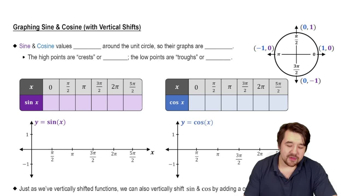
Graph of Sine and Cosine Function

Linear Equations

Linear equations represent straight lines and are typically expressed in the form y = mx + b, where m is the slope and b is the y-intercept. In the context of graph shifting, recognizing the components of a linear equation helps in understanding how changes to the equation affect the graph's position and orientation on the coordinate plane.
Recommended video:
07:17
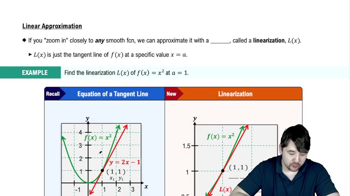
Linearization

Coordinate Plane

The coordinate plane is a two-dimensional surface defined by a horizontal axis (x-axis) and a vertical axis (y-axis). It is used to plot points, lines, and curves based on their x and y values. Familiarity with the coordinate plane is essential for graphing equations and understanding how shifts in the graph correspond to changes in the equation's parameters.
Recommended video:
7:42
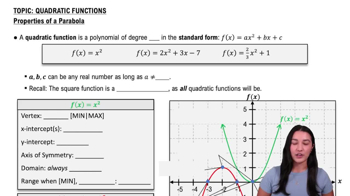
Properties of Parabolas