Ch. 3 - Derivatives
Briggs - Calculus: Early Transcendentals 3rd Edition
Briggs3rd EditionCalculus: Early TranscendentalsISBN: 9780136847243Not the one you use?Change textbook
Chapter 3, Problem 3.9.87.b

Explain why or why not. Determine whether the following statements are true and give an explanation or counterexample.


b. ln(x + 1) + ln(x − 1) = ln(x² − 1), for all x.

Verified step by step guidance
1
Step 1: Recall the logarithmic property that states \( \ln(a) + \ln(b) = \ln(ab) \). This property allows us to combine the logarithms on the left-hand side of the equation.
Step 2: Apply the property from Step 1 to the left-hand side: \( \ln(x + 1) + \ln(x - 1) = \ln((x + 1)(x - 1)) \).
Step 3: Simplify the expression \((x + 1)(x - 1)\) using the difference of squares formula: \((x + 1)(x - 1) = x^2 - 1\).
Step 4: Substitute the simplified expression from Step 3 back into the equation: \( \ln((x + 1)(x - 1)) = \ln(x^2 - 1) \).
Step 5: Conclude that the original statement \( \ln(x + 1) + \ln(x - 1) = \ln(x^2 - 1) \) is true for all \( x \) such that \( x > 1 \) or \( x < -1 \), because the domain of the logarithmic function requires that the arguments \( x + 1 \) and \( x - 1 \) are positive.

Verified video answer for a similar problem:

This video solution was recommended by our tutors as helpful for the problem above.
Video duration:
5m
Was this helpful?

Key Concepts

Here are the essential concepts you must grasp in order to answer the question correctly.

Properties of Logarithms

Logarithms have specific properties that govern their behavior, such as the product, quotient, and power rules. The product rule states that ln(a) + ln(b) = ln(ab), while the quotient rule states that ln(a) - ln(b) = ln(a/b). Understanding these properties is essential for manipulating logarithmic expressions and verifying the validity of statements involving logarithms.
Recommended video:
05:36
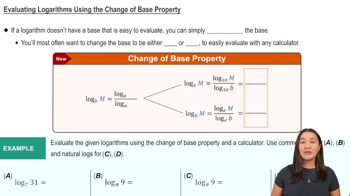
Change of Base Property

Domain of Logarithmic Functions

The domain of a logarithmic function is restricted to positive real numbers. For the expression ln(x + 1) + ln(x - 1), both x + 1 and x - 1 must be greater than zero, which implies x must be greater than 1. Recognizing the domain is crucial for determining the validity of logarithmic equations and ensuring that all terms are defined.
Recommended video:
5:26
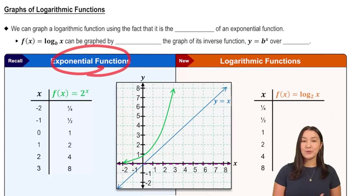
Graphs of Logarithmic Functions

Counterexamples in Mathematics

A counterexample is a specific case that disproves a general statement. In the context of the given logarithmic equation, finding a value of x that makes the left-hand side unequal to the right-hand side serves as a counterexample. This method is vital in mathematical reasoning, as it helps to establish the truth or falsehood of statements by demonstrating exceptions.
Recommended video:
05:13
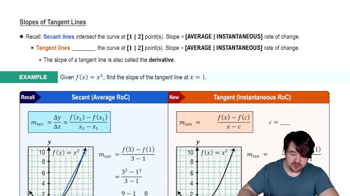
Slopes of Tangent Lines
Related Practice
Textbook Question

Vertical tangent lines

b. Does the curve have any horizontal tangent lines? Explain.

1
views

Textbook Question

45–50. Tangent lines Carry out the following steps. <IMAGE>

b. Determine an equation of the line tangent to the curve at the given point.

x³+y³=2xy; (1, 1)

Textbook Question

An object oscillates along a vertical line, and its position in centimeters is given by y(t) = 30(sint - 1), where t ≥ 0 is measured in seconds and y is positive in the upward direction.

Find the velocity of the oscillator, v(t) =y′(t).

Textbook Question

{Use of Tech} Hours of daylight The number of hours of daylight at any point on Earth fluctuates throughout the year. In the Northern Hemisphere, the shortest day is on the winter solstice and the longest day is on the summer solstice. At 40° north latitude, the length of a day is approximated by D(t) = 12−3 cos (2π(t+10) / 365), where D is measured in hours and 0≤t≤365 is measured in days, with t=0 corresponding to January 1.

b. Find the rate at which the daylight function changes.

Textbook Question

60–62. {Use of Tech} Multiple tangent lines Complete the following steps. <IMAGE>

b. Graph the tangent lines on the given graph.

4x³ =y²(4−x); x=2 (cissoid of Diocles)

1
views
Textbook Question

31–32. Velocity functions A projectile is fired vertically upward into the air, and its position (in feet) above the ground after t seconds is given by the function s(t).

b. Determine the instantaneous velocity of the projectile at t=1 and t = 2 seconds.

s(t)= −16t²+100t