Ch. 7 - Transcendental Functions
Hass - Thomas' Calculus 15th Edition
Hass15th EditionThomas' CalculusISBN: 9780137616077Not the one you use?Change textbook
Chapter 7, Problem 7.2.86

86. Use a derivative to show that g(x)=√(x² + ln x) is one-to-one.

Verified step by step guidance
1
Recall that a function is one-to-one if it is either strictly increasing or strictly decreasing on its domain. To use the derivative to show that \( g(x) = \sqrt{x^2 + \ln x} \) is one-to-one, we need to analyze the sign of \( g'(x) \).
First, identify the domain of \( g(x) \). Since \( \ln x \) is defined only for \( x > 0 \), the domain of \( g \) is \( (0, \infty) \).
Rewrite \( g(x) \) as \( g(x) = (x^2 + \ln x)^{1/2} \). Use the chain rule to find the derivative: \[ g'(x) = \frac{1}{2} (x^2 + \ln x)^{-1/2} \cdot \left( 2x + \frac{1}{x} \right) \].
Simplify the expression for \( g'(x) \): \[ g'(x) = \frac{2x + \frac{1}{x}}{2 \sqrt{x^2 + \ln x}} = \frac{2x + \frac{1}{x}}{2 \sqrt{x^2 + \ln x}}. \] Since the denominator \( 2 \sqrt{x^2 + \ln x} \) is positive for all \( x > 0 \), the sign of \( g'(x) \) depends on the numerator \( 2x + \frac{1}{x} \).
Analyze the numerator \( 2x + \frac{1}{x} \) for \( x > 0 \). Both terms are positive for all \( x > 0 \), so \( 2x + \frac{1}{x} > 0 \). Therefore, \( g'(x) > 0 \) for all \( x > 0 \), which means \( g(x) \) is strictly increasing on its domain and hence one-to-one.

Verified video answer for a similar problem:

This video solution was recommended by our tutors as helpful for the problem above.
Video duration:
3m
Was this helpful?

Key Concepts

Here are the essential concepts you must grasp in order to answer the question correctly.

Derivative and Monotonicity

The derivative of a function indicates its rate of change. If the derivative is always positive or always negative on an interval, the function is strictly increasing or decreasing there, respectively. This monotonic behavior implies the function is one-to-one on that interval.
Recommended video:
05:44
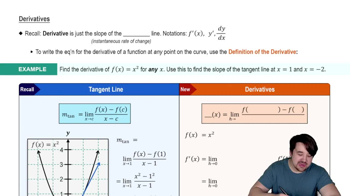
Derivatives

One-to-One Function (Injectivity)

A function is one-to-one if each output corresponds to exactly one input. This means no two different inputs produce the same output. Showing a function is strictly monotonic via its derivative is a common method to prove injectivity.
Recommended video:
05:50
One-Sided Limits

Differentiation of Composite and Logarithmic Functions

To find the derivative of g(x) = √(x² + ln x), apply the chain rule and differentiate each component. The derivative of ln x is 1/x, and the derivative of x² is 2x. Combining these correctly is essential to analyze the sign of g'(x).
Recommended video:
06:30
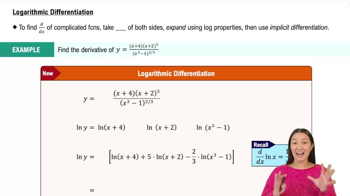
Logarithmic Differentiation