Ch. 3 - Derivatives
Briggs - Calculus: Early Transcendentals 3rd Edition
Briggs3rd EditionCalculus: Early TranscendentalsISBN: 9780136847243Not the one you use?Change textbook
Chapter 3, Problem 48

Reproduce the graph of f and then plot a graph of f' on the same axes. <IMAGE>

Verified step by step guidance
1
Step 1: Understand the function f(x) given in the problem. Analyze its behavior by identifying key features such as intercepts, asymptotes, and intervals of increase or decrease.
Step 2: Determine the derivative f'(x) of the function f(x). Use differentiation rules such as the power rule, product rule, quotient rule, or chain rule as applicable.
Step 3: Analyze the derivative f'(x) to understand the behavior of the original function f(x). Identify critical points where f'(x) = 0 or is undefined, as these points indicate potential local maxima, minima, or points of inflection.
Step 4: Sketch the graph of f(x) using the information gathered from the analysis. Plot key points and use the behavior of f'(x) to determine the shape of the graph, such as where it is increasing or decreasing.
Step 5: On the same axes, plot the graph of f'(x). Use the critical points and intervals of increase or decrease to accurately represent the derivative's behavior. This will help visualize the relationship between f(x) and f'(x).

Verified video answer for a similar problem:

This video solution was recommended by our tutors as helpful for the problem above.
Video duration:
4m
Was this helpful?

Key Concepts

Here are the essential concepts you must grasp in order to answer the question correctly.

Function Graphing

Graphing a function involves plotting points on a coordinate system that represent the output values of the function for given input values. This visual representation helps in understanding the behavior of the function, such as its increasing or decreasing intervals, local maxima and minima, and asymptotic behavior.
Recommended video:
5:53
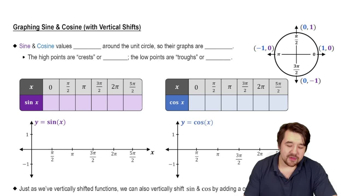
Graph of Sine and Cosine Function

Derivative

The derivative of a function, denoted as f', represents the rate of change of the function with respect to its variable. It provides information about the slope of the tangent line to the graph of the function at any given point, indicating where the function is increasing, decreasing, or has critical points.
Recommended video:
05:44
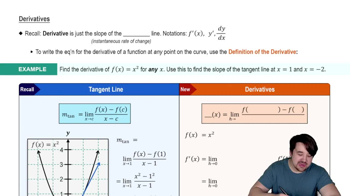
Derivatives

Graphing Derivatives

When graphing the derivative of a function alongside the original function, one can observe how the slope of the original function changes. The points where the derivative is zero correspond to the local maxima and minima of the original function, providing insights into its overall shape and behavior.
Recommended video:
06:15
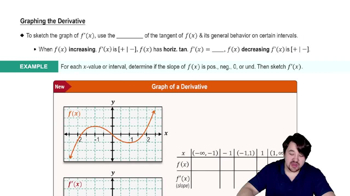
Graphing The Derivative