Ch. 4 - Applications of Derivatives
Hass - Thomas' Calculus 15th Edition
Hass15th EditionThomas' CalculusISBN: 9780137616077Not the one you use?Change textbook
Chapter 4, Problem 4.7.107

Motion with constant acceleration The standard equation for the position s of a body moving with a constant acceleration a along a coordinate line is s = (a/2)t² + v₀t + s₀, where v₀ and s₀ are the body’s velocity and position at time t = 0. Derive this equation by solving the initial value problem
Differential equation: d²s/dt² = a
Initial conditions: ds/dt = v₀ and s = s₀ when t=0.

Verified step by step guidance
1
Start with the given second-order differential equation: \(\frac{d^{2}s}{dt^{2}} = a\), where \(a\) is a constant acceleration.
Integrate the acceleration once with respect to time \(t\) to find the velocity \(v(t) = \frac{ds}{dt}\). This gives \(v(t) = \int a \, dt = a t + C_1\), where \(C_1\) is an integration constant.
Use the initial condition for velocity: at \(t=0\), \(v(0) = v_0\). Substitute to find \(C_1\): \(v_0 = a \cdot 0 + C_1\), so \(C_1 = v_0\). Thus, \(v(t) = a t + v_0\).
Integrate the velocity function \(v(t)\) with respect to time \(t\) to find the position function \(s(t)\): \(s(t) = \int (a t + v_0) \, dt = \frac{a}{2} t^{2} + v_0 t + C_2\), where \(C_2\) is another integration constant.
Use the initial condition for position: at \(t=0\), \(s(0) = s_0\). Substitute to find \(C_2\): \(s_0 = \frac{a}{2} \cdot 0^{2} + v_0 \cdot 0 + C_2\), so \(C_2 = s_0\). Therefore, the position function is \(s(t) = \frac{a}{2} t^{2} + v_0 t + s_0\).

Verified video answer for a similar problem:

This video solution was recommended by our tutors as helpful for the problem above.
Video duration:
4m
Was this helpful?

Key Concepts

Here are the essential concepts you must grasp in order to answer the question correctly.

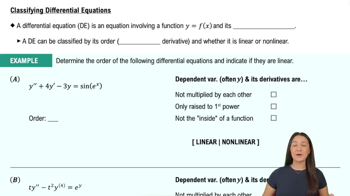
Second-Order Differential Equations

A second-order differential equation involves the second derivative of a function, representing acceleration in this context. Solving such equations requires integrating twice to find the original function, here the position s(t). Understanding how to handle these equations is essential to derive motion formulas from acceleration.
Recommended video:
07:39
Classifying Differential Equations

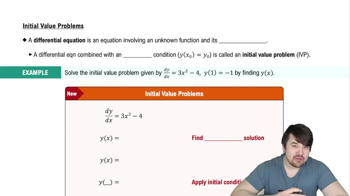
Initial Value Problems

An initial value problem specifies the values of a function and its derivatives at a particular point, allowing unique solutions to differential equations. Here, the initial velocity v₀ and position s₀ at time t=0 provide conditions to determine integration constants after solving the differential equation.
Recommended video:
05:03
Initial Value Problems

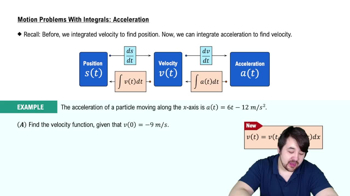
Kinematic Equations for Constant Acceleration

Kinematic equations describe motion under constant acceleration, linking position, velocity, acceleration, and time. The given formula s = (a/2)t² + v₀t + s₀ is derived by integrating acceleration twice and applying initial conditions, illustrating the connection between calculus and classical mechanics.
Recommended video:
08:14
Using The Acceleration Function