
Ch. 8 - Techniques of Integration
Hass - Thomas' Calculus 15th Edition
Hass15th EditionThomas' CalculusISBN: 9780137616077Not the one you use?Change textbook
Chapter 8, Problem 8.1.42

The integrals in Exercises 1–44 are in no particular order. Evaluate each integral using any algebraic method, trigonometric identity, or substitution you think is appropriate.
∫ ((2ˣ - 1) / 3ˣ) dx

Verified step by step guidance
1
Rewrite the integrand to express it in terms of exponential functions with the same base. Note that \$3^x\( can be written as \(e^{x \ln(3)}\) and \)2^x$ as \(e^{x \ln(2)}\). So, rewrite the integrand as \(\frac{2^x - 1}{3^x} = \frac{e^{x \ln(2)} - 1}{e^{x \ln(3)}}\).
Simplify the expression by splitting the fraction into two terms: \(\frac{e^{x \ln(2)}}{e^{x \ln(3)}} - \frac{1}{e^{x \ln(3)}} = e^{x (\ln(2) - \ln(3))} - e^{-x \ln(3)}\).
Recognize that \(\ln(2) - \ln(3) = \ln\left(\frac{2}{3}\right)\), so the integrand becomes \(e^{x \ln(\frac{2}{3})} - e^{-x \ln(3)}\).
Set up the integral as the sum of two integrals: \(\int e^{x \ln(\frac{2}{3})} dx - \int e^{-x \ln(3)} dx\).
Integrate each term separately using the formula \(\int e^{ax} dx = \frac{1}{a} e^{ax} + C\). For the first integral, \(a = \ln\left(\frac{2}{3}\right)\), and for the second, \(a = -\ln(3)\). Write the antiderivatives accordingly.

Verified video answer for a similar problem:

This video solution was recommended by our tutors as helpful for the problem above.
Video duration:
1m
Was this helpful?

Key Concepts

Here are the essential concepts you must grasp in order to answer the question correctly.

Properties of Exponential Functions

Exponential functions have the form a^x, where the base a is a positive constant. Understanding how to manipulate expressions like 2^x and 3^x, including rewriting them using properties such as a^(x)/b^(x) = (a/b)^x, is essential for simplifying the integrand before integration.
Recommended video:
06:21
Properties of Functions

Integration of Exponential Functions

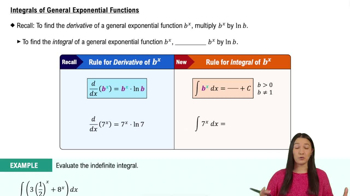
Integrating exponential functions involves recognizing that the integral of a^x with respect to x is (a^x) / (ln a) + C, where a > 0 and a ≠ 1. This formula is crucial for evaluating integrals containing terms like (2/3)^x or 3^{-x} after simplification.
Recommended video:
05:11
Integrals of General Exponential Functions

Algebraic Manipulation and Simplification

Before integrating, it is often necessary to simplify the integrand by algebraic manipulation, such as separating terms, factoring, or rewriting expressions. This step helps to transform the integral into a sum or difference of simpler integrals that can be evaluated using standard methods.
Recommended video:
05:25
Determine Continuity Algebraically