Ch. 8 - Techniques of Integration
Hass - Thomas' Calculus 15th Edition
Hass15th EditionThomas' CalculusISBN: 9780137616077Not the one you use?Change textbook
Chapter 8, Problem 8.8.14

The integrals in Exercises 1–34 converge. Evaluate the integrals without using tables.
∫₋∞^∞ (x dx) / (x² + 4)^(3/2)

Verified step by step guidance
1
Identify the integral to be evaluated: \(\displaystyle \int_{-\infty}^{\infty} \frac{x}{(x^{2} + 4)^{3/2}} \, dx\).
Observe the integrand function \(f(x) = \frac{x}{(x^{2} + 4)^{3/2}}\). Notice that the numerator is an odd function in \(x\) (since \(x\) is odd) and the denominator is an even function (depends on \(x^2\)). Therefore, the entire integrand is an odd function because the quotient of an odd function by an even function is odd.
Recall that the integral of an odd function over symmetric limits \([-a, a]\) is zero, provided the integral converges. Since the limits here are \(-\infty\) to \(\infty\), which are symmetric about zero, and the integral converges, the integral evaluates to zero.
Thus, without performing any complicated integration, conclude that the value of the integral is zero due to the odd symmetry of the integrand over symmetric limits.
If you want to verify convergence, consider the behavior of the integrand as \(x \to \infty\): the denominator grows like \(x^{3}\), and the numerator grows like \(x\), so the integrand behaves like \(\frac{x}{x^{3}} = \frac{1}{x^{2}}\), which is integrable over \([1, \infty)\), confirming convergence.

Verified video answer for a similar problem:

This video solution was recommended by our tutors as helpful for the problem above.
Video duration:
12m
Was this helpful?

Key Concepts

Here are the essential concepts you must grasp in order to answer the question correctly.

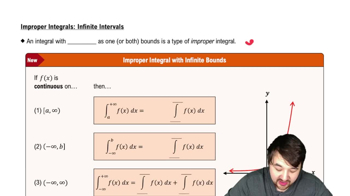
Improper Integrals

Improper integrals involve integration over infinite intervals or integrands with infinite discontinuities. To evaluate them, limits are used to define the integral as a limit of definite integrals over finite intervals. Understanding convergence is essential to determine if the integral has a finite value.
Recommended video:
11:11
Improper Integrals: Infinite Intervals

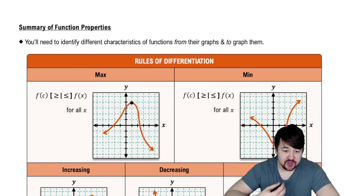
Symmetry of Functions

Symmetry properties of functions, such as evenness or oddness, simplify integration over symmetric intervals. An odd function satisfies f(-x) = -f(x), and its integral over [-a, a] is zero. Recognizing the integrand's symmetry can help evaluate the integral without explicit calculation.
Recommended video:
06:21
Properties of Functions

Substitution Method

The substitution method simplifies integrals by changing variables to transform the integrand into a more manageable form. It involves choosing a substitution that reduces complexity, often turning complicated expressions into standard integral forms, facilitating direct evaluation.
Recommended video:
07:33
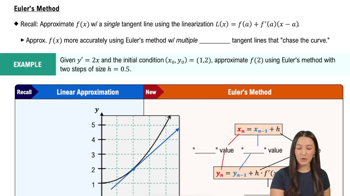
Euler's Method