
Ch. 4 - Applications of the Derivative
Briggs - Calculus: Early Transcendentals 3rd Edition
Briggs3rd EditionCalculus: Early TranscendentalsISBN: 9780136847243Not the one you use?Change textbook
Chapter 4, Problem 4.9.109c

107–110. {Use of Tech} Motion with gravity Consider the following descriptions of the vertical motion of an object subject only to the acceleration due to gravity. Begin with the acceleration equation a(t) = v' (t) = -g , where g = 9.8 m/s² .
c. Find the time when the object reaches its highest point. What is the height? 
A payload is released at an elevation of 400 m from a hot-air balloon that is rising at a rate of 10 m/s.

Verified step by step guidance
1
Step 1: Start with the given acceleration equation: a(t)=-g, where g is the acceleration due to gravity (9.8 m/s²). Integrate this equation to find the velocity function v(t). The integration gives v(t)=-gt+v0, where v0 is the initial velocity.
Step 2: Substitute the initial velocity of the payload, which is given as 10 m/s (the rate at which the hot-air balloon is rising), into the velocity equation. This gives v(t)=-9.8t+10.
Step 3: To find the time when the object reaches its highest point, set the velocity v(t) equal to zero (since the object momentarily stops moving upward at its highest point). Solve the equation -9.8t+10=0 for t.
Step 4: Once the time t is found, use the position equation to find the height at this time. The position equation is obtained by integrating the velocity equation: s(t)=-12gt2+v0t+s0, where s0 is the initial elevation (400 m).
Step 5: Substitute the values for g, v0, s0, and the time t (found in Step 3) into the position equation to calculate the height of the object at its highest point.

Verified video answer for a similar problem:

This video solution was recommended by our tutors as helpful for the problem above.
Video duration:
7m
Was this helpful?

Key Concepts

Here are the essential concepts you must grasp in order to answer the question correctly.

Acceleration due to Gravity

Acceleration due to gravity, denoted as 'g', is a constant that represents the rate at which an object accelerates towards the Earth when in free fall. On Earth, this value is approximately 9.8 m/s². In the context of vertical motion, it is crucial for determining how quickly an object's velocity changes as it moves upward or downward.
Recommended video:
06:51
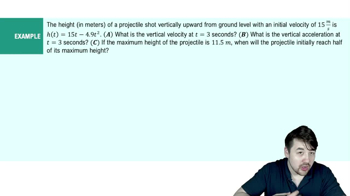
Derivatives Applied To Acceleration Example 2

Velocity and its Relationship to Acceleration

Velocity is the rate of change of an object's position with respect to time, and it can be affected by acceleration. In this scenario, the object's initial velocity is given as 10 m/s (upward). Understanding how to apply the acceleration due to gravity to this initial velocity is essential for calculating the object's motion and determining when it reaches its highest point.
Recommended video:
06:15
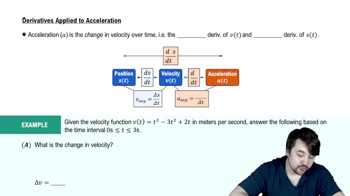
Derivatives Applied To Acceleration

Maximum Height in Projectile Motion

The maximum height of an object in projectile motion occurs when its velocity becomes zero before it starts descending. To find this height, one can use kinematic equations that relate initial velocity, acceleration, and displacement. In this case, the object released from the balloon will rise until the upward velocity is countered by the downward acceleration due to gravity.
Recommended video:
06:51
Derivatives Applied To Acceleration Example 2
Related Practice
Textbook Question

if ƒ(x) = 1 / (3x⁴ + 5) , it can be shown that ƒ'(x) = 12x³ / (3x⁴ + 5)² and ƒ"(x) = 180x² (x² + 1) (x + 1) (x - 1) / (3x⁴ + 5)³ . Use these functions to complete the following steps.


d. Identify the local extreme values and inflection points of ƒ .

Textbook Question

{Use of Tech} A damped oscillator The displacement of an object as it bounces vertically up and down on a spring is given by y(t) = 2.5e⁻ᵗ cos 2t, where the initial displacement is y(0) = 2.5 and y = 0 corresponds to the rest position (see figure). <IMAGE>


c. Find the time at which the object passes the rest position for the second time.

1
views
Textbook Question

{Use of Tech} Elliptic curves The equation y² = x³ - ax + 3, where a is a parameter, defines a well-known family of elliptic curves.


c. By experimentation, determine the approximate value of a (3 < a < 4)at which the graph separates into two curves.

Textbook Question

Population models The population of a species is given by the function P(t) = Kt²/(t² + b) , where t ≥ 0 is measured in years and K and b are positive real numbers.


c. For arbitrary positive values of K and b, when does the maximum growth rate occur (in terms of K and b)?

Textbook Question

{Use of Tech} Fixed points of quadratics and quartics Let f(x) = ax(1 -x), where a is a real number and 0 ≤ a ≤ 1. Recall that the fixed point of a function is a value of x such that f(x) = x (Exercises 48–51). 


c. Graph g for a = 2, 3, and 4.

Textbook Question

Explain why or why not Determine whether the following statements are true and give an explanation or counterexample.


c. If f(x) = mx + b, then the linear approximation to f at any point is L(x) = f(x).