
Ch. 4 - Applications of the Derivative
Briggs - Calculus: Early Transcendentals 3rd Edition
Briggs3rd EditionCalculus: Early TranscendentalsISBN: 9780136847243Not the one you use?Change textbook
Chapter 4, Problem 4.8.58c

{Use of Tech} Fixed points of quadratics and quartics Let f(x) = ax(1 -x), where a is a real number and 0 ≤ a ≤ 1. Recall that the fixed point of a function is a value of x such that f(x) = x (Exercises 48–51). 


c. Graph g for a = 2, 3, and 4.

Verified step by step guidance
1
Understand the concept of a fixed point: A fixed point of a function f(x) is a value x such that f(x) = x. This means that when you substitute x into the function, the output is the same as the input.
For the function f(x) = ax(1 - x), we need to find the fixed points by solving the equation f(x) = x. This translates to ax(1 - x) = x.
Rearrange the equation ax(1 - x) = x to find the values of x that satisfy it. Start by expanding the left side: ax - ax^2 = x.
Move all terms to one side to form a quadratic equation: ax - ax^2 - x = 0, which simplifies to (a - 1)x - ax^2 = 0.
Factor the quadratic equation or use the quadratic formula to find the values of x. The solutions to this equation will be the fixed points of the function for the given values of a.

Verified video answer for a similar problem:

This video solution was recommended by our tutors as helpful for the problem above.
Video duration:
6m
Was this helpful?

Key Concepts

Here are the essential concepts you must grasp in order to answer the question correctly.

Fixed Points

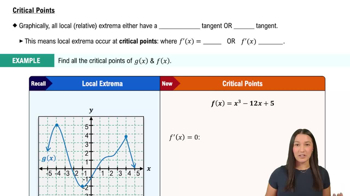
A fixed point of a function is a value of x where the function's output equals its input, i.e., f(x) = x. This concept is crucial for understanding the behavior of functions, as fixed points can indicate stable or unstable equilibria. In the context of the given function f(x) = ax(1 - x), finding fixed points involves solving the equation ax(1 - x) = x.
Recommended video:
04:50
Critical Points

Quadratic Functions

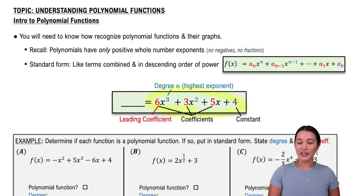
Quadratic functions are polynomial functions of degree two, typically expressed in the form f(x) = ax^2 + bx + c. The function provided, f(x) = ax(1 - x), can be rewritten as f(x) = -ax^2 + ax, which is a quadratic function. Understanding the properties of quadratics, such as their parabolas' shapes and vertex locations, is essential for graphing and analyzing the function's behavior.
Recommended video:
6:04
Introduction to Polynomial Functions

Graphing Techniques

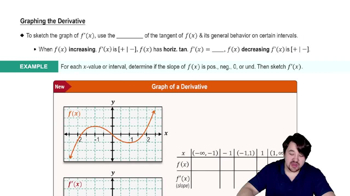
Graphing techniques involve plotting points and understanding the shape and behavior of functions on a coordinate plane. For the function f(x) = ax(1 - x), varying the parameter 'a' affects the width and position of the parabola. When graphing for different values of 'a' (2, 3, and 4), one must consider how these changes influence the fixed points and overall graph shape, which is vital for visualizing the function's dynamics.
Recommended video:
06:15
Graphing The Derivative
Related Practice
Textbook Question

107–110. {Use of Tech} Motion with gravity Consider the following descriptions of the vertical motion of an object subject only to the acceleration due to gravity. Begin with the acceleration equation a(t) = v' (t) = -g , where g = 9.8 m/s² .

d. Find the time when the object strikes the ground.

A payload is released at an elevation of 400 m from a hot-air balloon that is rising at a rate of 10 m/s.

Textbook Question

if ƒ(x) = 1 / (3x⁴ + 5) , it can be shown that ƒ'(x) = 12x³ / (3x⁴ + 5)² and ƒ"(x) = 180x² (x² + 1) (x + 1) (x - 1) / (3x⁴ + 5)³ . Use these functions to complete the following steps.


d. Identify the local extreme values and inflection points of ƒ .

Textbook Question

{Use of Tech} A damped oscillator The displacement of an object as it bounces vertically up and down on a spring is given by y(t) = 2.5e⁻ᵗ cos 2t, where the initial displacement is y(0) = 2.5 and y = 0 corresponds to the rest position (see figure). <IMAGE>


c. Find the time at which the object passes the rest position for the second time.

1
views
Textbook Question

{Use of Tech} Elliptic curves The equation y² = x³ - ax + 3, where a is a parameter, defines a well-known family of elliptic curves.


c. By experimentation, determine the approximate value of a (3 < a < 4)at which the graph separates into two curves.

Textbook Question

Population models The population of a species is given by the function P(t) = Kt²/(t² + b) , where t ≥ 0 is measured in years and K and b are positive real numbers.


c. For arbitrary positive values of K and b, when does the maximum growth rate occur (in terms of K and b)?

Textbook Question

107–110. {Use of Tech} Motion with gravity Consider the following descriptions of the vertical motion of an object subject only to the acceleration due to gravity. Begin with the acceleration equation a(t) = v' (t) = -g , where g = 9.8 m/s² .

c. Find the time when the object reaches its highest point. What is the height? 

A payload is released at an elevation of 400 m from a hot-air balloon that is rising at a rate of 10 m/s.

1
views