
Ch. 9 - Differential Equations
Briggs - Calculus: Early Transcendentals 3rd Edition
Briggs3rd EditionCalculus: Early TranscendentalsISBN: 9780136847243Not the one you use?Change textbook
Chapter 9, Problem 9.1.53d

52-56. In this section, several models are presented and the solution of the associated differential equation is given. Later in the chapter, we present methods for solving these differential equations.


where P(t) is the population, for t ≥ 0, and r > 0 and K > 0 are given constants.


d. Find lim(t→∞) P(t) and check that the result is consistent with the graph in part (c).

Verified step by step guidance
1
Identify the differential equation model given for the population \(P(t)\(, which is typically the logistic growth model: \[\frac{dP}{dt} = rP\left(1 - \frac{P}{K}\right),\] where \)r > 0\) is the growth rate and \(K > 0\) is the carrying capacity.
Understand that the equilibrium solutions occur when the growth rate is zero, i.e., when \[\frac{dP}{dt} = 0.\] This happens if either \(P = 0\) or \(P = K\).
Analyze the stability of these equilibrium points: since \(r > 0\), \(P = 0\) is an unstable equilibrium and \(P = K\) is a stable equilibrium, meaning the population tends to \(K\) as \(t \to \infty\).
Therefore, to find \[\lim_{t \to \infty} P(t),\] recognize that the solution \(P(t)\) approaches the stable equilibrium \(K\) over time.
Finally, verify that this limit is consistent with the graph in part (c), which should show the population leveling off at the carrying capacity \(K\) as time increases.

Verified video answer for a similar problem:

This video solution was recommended by our tutors as helpful for the problem above.
Video duration:
2m
Was this helpful?

Key Concepts

Here are the essential concepts you must grasp in order to answer the question correctly.

Logistic Differential Equation

The logistic differential equation models population growth with a carrying capacity, expressed as dP/dt = rP(1 - P/K). Here, P(t) is the population at time t, r is the growth rate, and K is the maximum sustainable population. Understanding this equation helps analyze how populations grow and stabilize over time.
Recommended video:
07:39
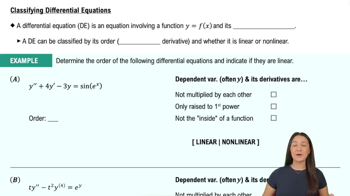
Classifying Differential Equations

Limit of a Function as t Approaches Infinity

The limit lim(t→∞) P(t) describes the long-term behavior of the population. Evaluating this limit reveals the steady-state or equilibrium population size. In logistic growth, this limit typically equals the carrying capacity K, indicating population stabilization.
Recommended video:
06:11
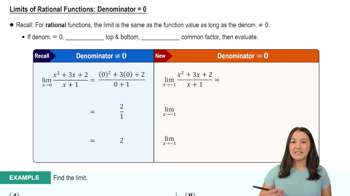
Limits of Rational Functions: Denominator = 0

Equilibrium Solutions and Stability

Equilibrium solutions occur when the population does not change over time (dP/dt = 0). For the logistic model, P = 0 and P = K are equilibria. Stability analysis shows that P = K is stable, meaning the population tends to this value as t increases, consistent with the graph's behavior.
Recommended video:
04:00
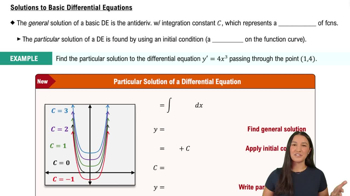
Solutions to Basic Differential Equations
Related Practice
Textbook Question

33–36. {Use of Tech} Computing Euler approximations Use a calculator or computer program to carry out the following steps.

d. Compare the errors in the approximations to y(T).


y′(t) = 6 - 2y, y(0) = -1; Δt = 0.2, T = 3; y(t) = 3 - 4e⁻²ᵗ

1
views
Textbook Question

{Use of Tech} Fish harvesting A fish hatchery has 500 fish at t=0, when harvesting begins at a rate of b>0fish/year The fish population is modeled by the initial value problem y′(t)=0.01y−b,y(0)=500 where t is measured in years.


c. Graph the solution in the case that b=60fish/year. Describe the solution.

1
views
Textbook Question

17–20. Increasing and decreasing solutions Consider the following differential equations. A detailed direction field is not needed.


c. Which initial conditions y(0) = A lead to solutions that are increasing in time? Decreasing?


y'(t) = cos y for |y| ≤ π

1
views
Textbook Question

[Use of Tech] Analysis of a separable equation Consider the differential equation yy'(t) = ½eᵗ + t and carry out the following analysis.

c. Graph the solutions in part (b) and describe their behavior as t increases. 

Textbook Question

A second-order equation Consider the differential equation y''(t) - k²y(t) = 0 where k > 0 is a real number.


d. For a positive real number k, verify that the general solution of the equation may also be expressed in the form y(t) = C₁cosh(kt) + C₂sinh(kt), where cosh and sinh are the hyperbolic cosine and hyperbolic sine, respectively (Section 7.3).

Textbook Question

29–32. {Use of Tech} Errors in Euler’s method Consider the following initial value problems.


d. In general, how does halving the time step affect the error at t=0.2 and t=0.4?


y′(t) = y/2, y(0) = 2; y(t) = 2eᵗᐟ²