
Ch. 9 - Differential Equations
Briggs - Calculus: Early Transcendentals 3rd Edition
Briggs3rd EditionCalculus: Early TranscendentalsISBN: 9780136847243Not the one you use?Change textbook
Chapter 9, Problem 9.2.19c

17–20. Increasing and decreasing solutions Consider the following differential equations. A detailed direction field is not needed.


c. Which initial conditions y(0) = A lead to solutions that are increasing in time? Decreasing?


y'(t) = cos y for |y| ≤ π

Verified step by step guidance
1
First, understand that the differential equation is given by \(y'(t) = \cos y\), where \(y\) depends on \(t\) and \(|y| \leq \pi\).
Recall that the sign of \(y'(t)\) determines whether the solution \(y(t)\) is increasing or decreasing at time \(t\). Specifically, if \(y'(t) > 0\), then \(y(t)\) is increasing; if \(y'(t) < 0\), then \(y(t)\) is decreasing.
Since \(y'(t) = \cos y\), analyze the values of \(\cos y\) for \(y\) in the interval \([-\pi, \pi]\). Identify where \(\cos y\) is positive, zero, or negative.
Determine the initial conditions \(y(0) = A\) such that \(\cos A > 0\) (leading to increasing solutions) and \(\cos A < 0\) (leading to decreasing solutions). Also note the points where \(\cos A = 0\), which correspond to equilibrium solutions where \(y(t)\) does not change.
Summarize the intervals of \(A\) where solutions increase or decrease based on the sign of \(\cos A\), considering the periodic and even nature of the cosine function within the given domain.

Verified video answer for a similar problem:

This video solution was recommended by our tutors as helpful for the problem above.
Video duration:
3m
Was this helpful?

Key Concepts

Here are the essential concepts you must grasp in order to answer the question correctly.

Differential Equations and Initial Conditions

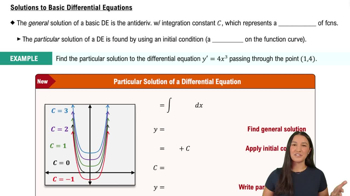
A differential equation relates a function and its derivatives. The initial condition y(0) = A specifies the starting value of the solution, which influences the behavior of the solution curve over time. Understanding how initial values affect solutions is key to predicting whether the solution increases or decreases.
Recommended video:
04:00
Solutions to Basic Differential Equations

Sign of the Derivative and Monotonicity

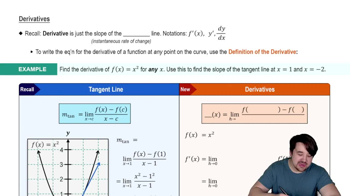
The sign of y'(t) determines whether the solution y(t) is increasing or decreasing. If y'(t) > 0, the solution is increasing; if y'(t) < 0, it is decreasing. Analyzing the expression y'(t) = cos y helps identify intervals of y where the solution grows or shrinks.
Recommended video:
05:44
Derivatives

Properties of the Cosine Function on the Interval |y| ≤ π

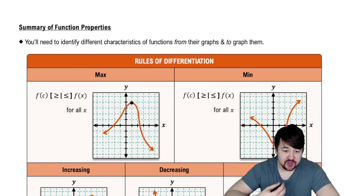
Cosine varies between -1 and 1 and is positive on (-π/2, π/2) and negative on (π/2, π) and (-π, -π/2). Since y'(t) = cos y, the sign of cos y depends on y's value, which determines whether the solution increases or decreases. Recognizing these intervals is essential for classifying initial conditions.
Recommended video:
06:21
Properties of Functions
Related Practice
Textbook Question

38–43. Equilibrium solutions A differential equation of the form y′(t)=f(y) is said to be autonomous (the function f depends only on y). The constant function y=y0 is an equilibrium solution of the equation provided f(y0)=0 (because then y'(t)=0 and the solution remains constant for all t). Note that equilibrium solutions correspond to horizontal lines in the direction field. Note also that for autonomous equations, the direction field is independent of t. Carry out the following analysis on the given equations.

c. Sketch the solution curve that corresponds to the initial condition y0=1. 


y′(t) = 6 - 2y

1
views
Textbook Question

52-56. In this section, several models are presented and the solution of the associated differential equation is given. Later in the chapter, we present methods for solving these differential equations.


where P(t) is the population, for t ≥ 0, and r > 0 and K > 0 are given constants.


d. Find lim(t→∞) P(t) and check that the result is consistent with the graph in part (c).

Textbook Question

Cooling time Suppose an object with an initial temperature of T₀ > 0 is put in surroundings with an ambient temperature of A, where A < T₀/2. Let t₁/₂ be the time required for the object to cool to T₀/2.


c. Why is the condition A < T₀/2 needed?

1
views
Textbook Question

{Use of Tech} Fish harvesting A fish hatchery has 500 fish at t=0, when harvesting begins at a rate of b>0fish/year The fish population is modeled by the initial value problem y′(t)=0.01y−b,y(0)=500 where t is measured in years.


c. Graph the solution in the case that b=60fish/year. Describe the solution.

1
views
Textbook Question

[Use of Tech] Analysis of a separable equation Consider the differential equation yy'(t) = ½eᵗ + t and carry out the following analysis.

c. Graph the solutions in part (b) and describe their behavior as t increases. 

Textbook Question

A second-order equation Consider the differential equation y''(t) - k²y(t) = 0 where k > 0 is a real number.


d. For a positive real number k, verify that the general solution of the equation may also be expressed in the form y(t) = C₁cosh(kt) + C₂sinh(kt), where cosh and sinh are the hyperbolic cosine and hyperbolic sine, respectively (Section 7.3).