Ch. 1 - Functions
Briggs - Calculus: Early Transcendentals 3rd Edition
Briggs3rd EditionCalculus: Early TranscendentalsISBN: 9780136847243Not the one you use?Change textbook
Chapter 1, Problem 99

Identify the amplitude and period of the following functions.
q(x)=3.6cos(πx24)q\(\left\)(x\(\right\))=3.6\(\cos\[\left\)(\(\frac{\pi x}{24}\]\right\))

Verified step by step guidance
1
The function given is q(x) = 3.6 \(\cos\[\left\)(\(\frac{\pi x}{24}\]\right\)). This is a cosine function of the form a \(\cos\)(bx), where 'a' is the amplitude and 'b' affects the period.
Identify the amplitude: In the function q(x) = 3.6 \(\cos\[\left\)(\(\frac{\pi x}{24}\]\right\)), the coefficient 'a' in front of the cosine function is 3.6. Therefore, the amplitude is 3.6.
Determine the period: The period of a cosine function a \(\cos\)(bx) is given by \(\frac{2\pi}{b}\).
In the function q(x) = 3.6 \(\cos\[\left\)(\(\frac{\pi x}{24}\]\right\)), the value of 'b' is \(\frac{\pi}{24}\).
Calculate the period using the formula: Substitute b = \(\frac{\pi}{24}\) into the period formula \(\frac{2\pi}{b}\) to find the period of the function.

Verified video answer for a similar problem:

This video solution was recommended by our tutors as helpful for the problem above.
Video duration:
3m
Was this helpful?

Key Concepts

Here are the essential concepts you must grasp in order to answer the question correctly.

Amplitude

Amplitude refers to the maximum distance a wave reaches from its central position, which in the context of a cosine function is the coefficient in front of the cosine term. For the function q(x) = 3.6cos(πx/24), the amplitude is 3.6, indicating that the function oscillates between 3.6 and -3.6.
Recommended video:
3:40
Introduction to Cotangent Graph Example 1

Period

The period of a function describes the length of one complete cycle of the wave. For a cosine function of the form cos(kx), the period can be calculated using the formula P = 2π/k. In this case, k is π/24, leading to a period of P = 2π/(π/24) = 48, meaning the function completes one full cycle every 48 units along the x-axis.
Recommended video:
5:43
Introduction to Tangent Graph

Cosine Function

The cosine function is a fundamental trigonometric function that describes the relationship between the angle and the lengths of the sides of a right triangle. It is periodic, oscillating between -1 and 1, and is often used to model wave-like phenomena. In the given function, the cosine term dictates the shape and behavior of the wave, influenced by its amplitude and period.
Recommended video:
5:53
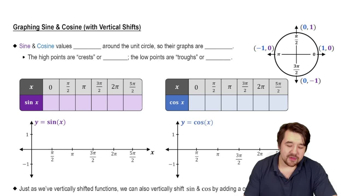
Graph of Sine and Cosine Function