Ch. 8 - Integration Techniques
Briggs - Calculus: Early Transcendentals 3rd Edition
Briggs3rd EditionCalculus: Early TranscendentalsISBN: 9780136847243Not the one you use?Change textbook
Chapter 8, Problem 8.1.16

7–64. Integration review Evaluate the following integrals.
16. ∫ from 0 to 1 of (t² / (1 + t⁶)) dt

Verified step by step guidance
1
Step 1: Recognize that the integral ∫ from 0 to 1 of (t² / (1 + t⁶)) dt involves a rational function. Look for substitution techniques to simplify the integrand.
Step 2: Let u = 1 + t⁶. Then, compute the derivative of u with respect to t: du/dt = 6t⁵. Rearrange to express dt in terms of du: dt = du / (6t⁵).
Step 3: Substitute u and dt into the integral. Replace t² using the substitution u = 1 + t⁶, which implies t² = (u - 1)^(1/3). The integral becomes ∫ (u - 1)^(1/3) / (6t⁵ * u) du.
Step 4: Simplify the expression further by substituting t⁵ in terms of u. From u = 1 + t⁶, t⁵ = ((u - 1)^(5/6)). Replace t⁵ in the denominator and simplify the integrand.
Step 5: Evaluate the resulting integral with respect to u over the transformed limits (from u = 1 to u = 2). Use standard integration techniques or numerical methods if necessary.

Verified video answer for a similar problem:

This video solution was recommended by our tutors as helpful for the problem above.
Video duration:
2m
Was this helpful?

Key Concepts

Here are the essential concepts you must grasp in order to answer the question correctly.

Definite Integrals

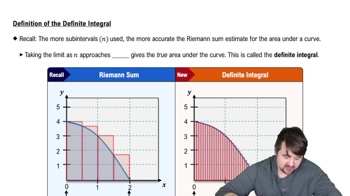
A definite integral calculates the accumulation of a quantity, represented as the area under a curve, between two specified limits. In this case, the integral from 0 to 1 of the function t² / (1 + t⁶) indicates that we are interested in the total area under the curve of this function from t = 0 to t = 1.
Recommended video:
05:43
Definition of the Definite Integral

Integration Techniques

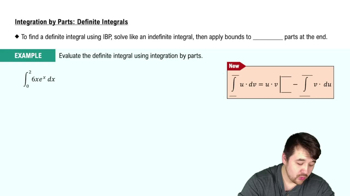
To evaluate integrals, various techniques can be employed, such as substitution, integration by parts, or recognizing standard forms. For the integral ∫ (t² / (1 + t⁶)) dt, one might consider substitution to simplify the integrand, making it easier to compute the area under the curve.
Recommended video:
06:18
Integration by Parts for Definite Integrals

Continuous Functions

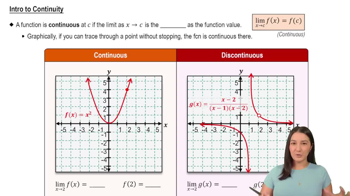
The function being integrated, t² / (1 + t⁶), is continuous over the interval [0, 1]. Continuous functions are essential in calculus because they ensure that the definite integral can be computed without any breaks or discontinuities, allowing for the application of the Fundamental Theorem of Calculus.
Recommended video:
05:34
Intro to Continuity