Ch. 8 - Integration Techniques
Briggs - Calculus: Early Transcendentals 3rd Edition
Briggs3rd EditionCalculus: Early TranscendentalsISBN: 9780136847243Not the one you use?Change textbook
Chapter 8, Problem 8.9.108

108. Draining a tank Water is drained from a 3000-gal tank at a rate that starts at 100 gal/hr and decreases continuously by 5%/hr. If the drain is left open indefinitely, how much water drains from the tank? Can a full tank be emptied at this rate? 

Verified step by step guidance
1
Identify the initial rate of draining water from the tank, which is given as 100 gallons per hour. This is the starting value of the rate function, denoted as \(R(0) = 100\) gal/hr.
Recognize that the rate decreases continuously by 5% per hour. This means the rate function \(R(t)\) can be modeled as an exponential decay function: \(R(t) = 100 \times (1 - 0.05)^t = 100 \times 0.95^t\), where \(t\) is time in hours.
To find the total amount of water drained over an indefinite period, set up the integral of the rate function from \(t=0\) to \(t=\infty\): \(\displaystyle \int_0^{\infty} R(t) \, dt = \int_0^{\infty} 100 \times 0.95^t \, dt\).
Rewrite the integral using the exponential function with natural logarithm for easier integration: \(0.95^t = e^{t \ln(0.95)}\), so the integral becomes \(\int_0^{\infty} 100 e^{t \ln(0.95)} \, dt\).
Evaluate the improper integral by integrating \(100 e^{t \ln(0.95)}\) with respect to \(t\) from 0 to infinity, and interpret the result to determine if the total drained water exceeds the tank's capacity of 3000 gallons.

Verified video answer for a similar problem:

This video solution was recommended by our tutors as helpful for the problem above.
Video duration:
4m
Was this helpful?

Key Concepts

Here are the essential concepts you must grasp in order to answer the question correctly.

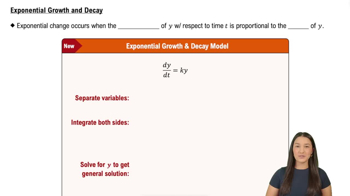
Exponential Decay

Exponential decay describes a quantity that decreases at a rate proportional to its current value. In this problem, the draining rate decreases by 5% per hour, meaning the rate follows an exponential decay model, often expressed as R(t) = R_0 * e^(-kt), where k is the decay constant.
Recommended video:
09:29
Exponential Growth & Decay

Integration of Rate Functions

To find the total amount of water drained over time, you integrate the rate function with respect to time. This accumulates the volume drained from the start until any given time, allowing calculation of total drained water as the integral of the decreasing flow rate.
Recommended video:
04:16
Intro To Related Rates

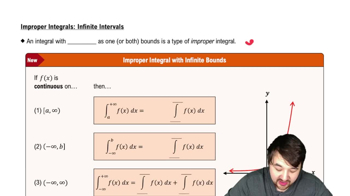
Limit of an Improper Integral

Since the drain is left open indefinitely, the total drained water is the limit of the integral as time approaches infinity. Evaluating this improper integral determines whether the tank can be fully emptied or if some water remains due to the decreasing rate.
Recommended video:
11:11
Improper Integrals: Infinite Intervals