Ch. 4 - Applications of Derivatives
Hass - Thomas' Calculus 15th Edition
Hass15th EditionThomas' CalculusISBN: 9780137616077Not the one you use?Change textbook
Chapter 4, Problem 4.4.101

101. In Exercises 101 and 102, the graph of f' is given. Determine x-values corresponding to local minima, local maxima, and inflection points for the graph of f.
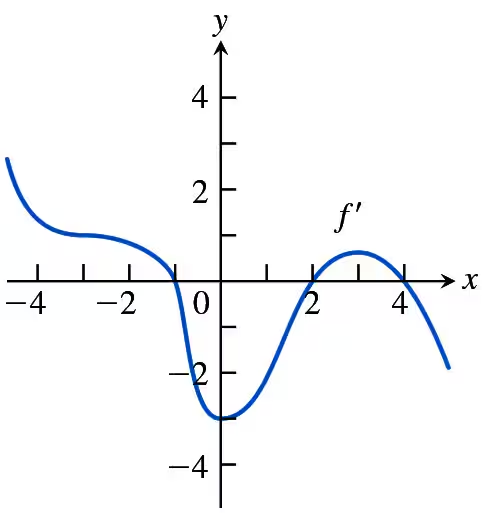
Graph of f' showing local minima and maxima, with x-axis ranging from -4 to 4 and y-axis from -4 to 4.

Verified step by step guidance
1
To find local minima and maxima of the function f, observe where the graph of f' crosses the x-axis. These points are where f' changes sign, indicating potential local extrema.
Identify the x-values where f' changes from positive to negative, which correspond to local maxima of f. In the graph, this occurs at x = -1.
Identify the x-values where f' changes from negative to positive, which correspond to local minima of f. In the graph, this occurs at x = 3.
To find inflection points of f, look for x-values where f' has local extrema, as these indicate changes in the concavity of f. In the graph, local extrema of f' occur at x = 1 and x = 4.
Summarize the findings: Local maxima occur at x = -1, local minima occur at x = 3, and inflection points occur at x = 1 and x = 4.

Verified video answer for a similar problem:

This video solution was recommended by our tutors as helpful for the problem above.
Video duration:
3m
Was this helpful?

Key Concepts

Here are the essential concepts you must grasp in order to answer the question correctly.

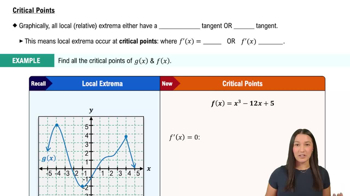
Critical Points

Critical points occur where the derivative of a function, f', is either zero or undefined. These points are essential for identifying local maxima and minima, as they indicate where the function's slope changes. In the context of the graph provided, critical points can be found where the graph of f' intersects the x-axis.
Recommended video:
04:50
Critical Points

Local Maxima and Minima

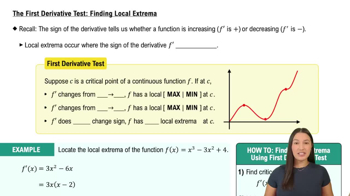
Local maxima and minima are points on the graph of a function where the function reaches a highest or lowest value, respectively, in a neighborhood around that point. To determine these points from the derivative graph, one looks for changes in the sign of f' around critical points: a change from positive to negative indicates a local maximum, while a change from negative to positive indicates a local minimum.
Recommended video:
07:09
The First Derivative Test: Finding Local Extrema

Inflection Points

Inflection points are points on the graph of a function where the concavity changes, which can be identified by examining the second derivative, f''. However, in the context of the derivative graph f', inflection points correspond to where f' changes from increasing to decreasing or vice versa. These points indicate a change in the behavior of the original function's curvature.
Recommended video:
04:50
Critical Points