Ch. 9 - Differential Equations
Briggs - Calculus: Early Transcendentals 3rd Edition
Briggs3rd EditionCalculus: Early TranscendentalsISBN: 9780136847243Not the one you use?Change textbook
Chapter 9, Problem 9.1.46

45–46. Harvesting problems Consider the harvesting problem in Example 6.
If r = 0.05 and H = 500, for what values of p₀ is the amount of the resource decreasing? For what value of p₀ is the amount of the resource constant? If p₀ = 9000, when does the resource vanish?

Verified step by step guidance
1
Recall the harvesting model differential equation from Example 6, which is typically of the form: \[\frac{dp}{dt} = rp - H,\] where \(p(t)\) is the amount of the resource at time \(t\), \(r\) is the growth rate, and \(H\) is the harvesting rate.
To determine when the amount of the resource is decreasing, analyze the sign of \[\frac{dp}{dt} = rp - H.\] The resource decreases when \[\frac{dp}{dt} < 0,\] which means \[rp - H < 0.\] Solve this inequality for \(p\) to find the values of \(p_0\) (initial amount) where the resource decreases.
To find when the amount of the resource is constant, set \[\frac{dp}{dt} = 0,\] which gives \[rp - H = 0.\] Solve for \(p\) to find the equilibrium value of \(p_0\) where the resource neither increases nor decreases.
Given \(p_0 = 9000\(, solve the differential equation \[\frac{dp}{dt} = rp - H\] with initial condition \)p(0) = 9000\) to find \(p(t)\). This is a first-order linear differential equation and can be solved using an integrating factor or separation of variables.
Once you have the explicit solution \(p(t)\), determine the time \(t\( when the resource vanishes by solving \[p(t) = 0\] for \)t\). This will give the time at which the resource is completely depleted.

Verified video answer for a similar problem:

This video solution was recommended by our tutors as helpful for the problem above.
Video duration:
5m
Was this helpful?

Key Concepts

Here are the essential concepts you must grasp in order to answer the question correctly.

Differential Equations in Population Dynamics

Differential equations model how populations change over time, incorporating growth and harvesting rates. In harvesting problems, the rate of change of the resource depends on natural growth minus the harvesting amount, allowing prediction of resource levels at any time.
Recommended video:
07:39
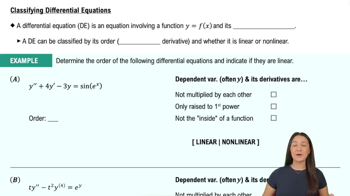
Classifying Differential Equations

Equilibrium Points and Stability

An equilibrium point occurs when the population remains constant over time, meaning growth equals harvesting. Determining the equilibrium helps identify values of the initial population where the resource neither grows nor declines, crucial for sustainable harvesting.
Recommended video:
04:50
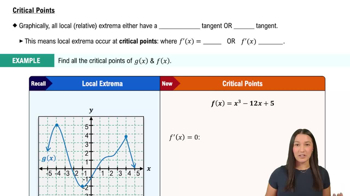
Critical Points

Time to Extinction in Resource Models

Time to extinction refers to when the resource population reaches zero under given harvesting and growth rates. Solving the differential equation with initial conditions allows calculation of when the resource vanishes, important for managing resource depletion.
Recommended video:
09:29
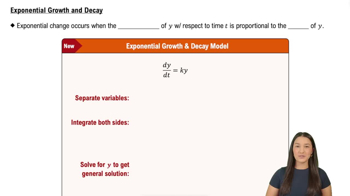
Exponential Growth & Decay