
Ch. 9 - Differential Equations
Briggs - Calculus: Early Transcendentals 3rd Edition
Briggs3rd EditionCalculus: Early TranscendentalsISBN: 9780136847243Not the one you use?Change textbook
Chapter 9, Problem 9.4.12

11–16. Initial value problems Solve the following initial value problems.


y'(x) = −y + 2, y(0) = −2

Verified step by step guidance
1
Identify the type of differential equation given. Here, the equation is a first-order linear ordinary differential equation of the form \(y'(x) + y = 2\).
Rewrite the differential equation in standard linear form: \(y' + p(x)y = q(x)\), where \(p(x) = 1\) and \(q(x) = 2\).
Find the integrating factor \(\mu(x)\) using the formula \(\mu(x) = e^{\int p(x) \, dx}\). Since \(p(x) = 1\), calculate \(\mu(x) = e^{\int 1 \, dx} = e^{x}\).
Multiply both sides of the differential equation by the integrating factor \(e^{x}\) to get \(e^{x} y' + e^{x} y = 2 e^{x}\). Recognize that the left side is the derivative of \(e^{x} y\) with respect to \(x\).
Integrate both sides with respect to \(x\): \(\int \frac{d}{dx} (e^{x} y) \, dx = \int 2 e^{x} \, dx\). Then solve for \(y(x)\) and apply the initial condition \(y(0) = -2\) to find the constant of integration.

Verified video answer for a similar problem:

This video solution was recommended by our tutors as helpful for the problem above.
Video duration:
2m
Was this helpful?

Key Concepts

Here are the essential concepts you must grasp in order to answer the question correctly.

First-Order Differential Equations

A first-order differential equation involves the first derivative of a function and the function itself. Solving such equations means finding a function y(x) that satisfies the given relationship between y' and y. In this problem, y'(x) = -y + 2 is a linear first-order differential equation.
Recommended video:
07:39
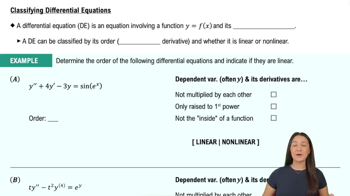
Classifying Differential Equations

Initial Value Problems (IVP)

An initial value problem specifies the value of the unknown function at a particular point, here y(0) = -2. This condition allows us to find a unique solution to the differential equation by determining the constant of integration after solving the general solution.
Recommended video:
05:03
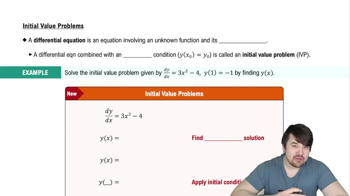
Initial Value Problems

Solving Linear Differential Equations Using Integrating Factors

Linear first-order differential equations can be solved using an integrating factor, which is a function that simplifies the equation into an exact derivative. Multiplying both sides by this factor allows integration and leads to the general solution, which can then be adjusted using the initial condition.
Recommended video:
06:06
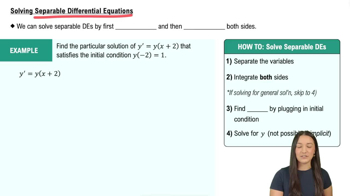
Solving Separable Differential Equations
Related Practice
Textbook Question

45–46. Harvesting problems Consider the harvesting problem in Example 6.

If r = 0.05 and H = 500, for what values of p₀ is the amount of the resource decreasing? For what value of p₀ is the amount of the resource constant? If p₀ = 9000, when does the resource vanish?

Textbook Question

11–16. Initial value problems Solve the following initial value problems.


y'(t) − 3y = 12, y(1) = 4

Textbook Question

39–42. Special equations A special class of first-order linear equations have the form a(t)y'(t)+a'(t)y(t)=f(t), where a and f are given functions of t. Notice that the left side of this equation can be written as the derivative of a product, so the equation has the form

a(t)y'(t) + a'(t)y(t) = d/dt (a(t)y(t)) = f(t). 

Therefore, the equation can be solved by integrating both sides with respect to t. Use this idea to solve the following initial value problems. 


(t² + 1)y′(t) + 2ty = 3t², y(2) = 8

Textbook Question

23–26. Loan problems The following initial value problems model the payoff of a loan. In each case, solve the initial value problem, for t≥0 graph the solution, and determine the first month in which the loan balance is zero.


B′(t) = 0.004B − 800, B(0) = 40,000

Textbook Question

Does the function y(t) = 2t satisfy the differential equation y'''(t) + y'(t) = 2?

Textbook Question

17–18. {Use of Tech} Designing logistic functions Use the method of Example 1 to find a logistic function that describes the following populations. Graph the population function.


The population increases from 50 to 60 in the first month and eventually levels off at 150.