Ch. 7 - Transcendental Functions
Hass - Thomas' Calculus 15th Edition
Hass15th EditionThomas' CalculusISBN: 9780137616077Not the one you use?Change textbook
Chapter 7, Problem 7.AAE.3

Find the limits in Exercises 1–6.
3. lim(x→0⁺) (cox(√x))^(1/x)

Verified step by step guidance
1
Identify the limit expression: \(\lim_{x \to 0^+} \left( \cos(\sqrt{x}) \right)^{\frac{1}{x}}\).
Recognize that the expression is of the form \(f(x)^{g(x)}\) where both the base and the exponent depend on \(x\), and direct substitution leads to an indeterminate form.
Rewrite the limit using the exponential and natural logarithm to handle the exponent: \(\lim_{x \to 0^+} e^{\frac{1}{x} \ln(\cos(\sqrt{x}))}\).
Focus on finding the limit of the exponent: \(\lim_{x \to 0^+} \frac{\ln(\cos(\sqrt{x}))}{x}\). Use series expansions or approximations for \(\cos(\sqrt{x})\) near 0 to simplify the logarithm.
Apply the appropriate limit techniques (such as L'Hôpital's Rule if needed) to evaluate the exponent limit, then substitute back into the exponential to find the original limit.

Verified video answer for a similar problem:

This video solution was recommended by our tutors as helpful for the problem above.
Video duration:
6m
Was this helpful?

Key Concepts

Here are the essential concepts you must grasp in order to answer the question correctly.

Limit of a function as x approaches a point

The limit describes the value that a function approaches as the input approaches a specific point. Understanding one-sided limits, such as x approaching 0 from the right (0⁺), is crucial when the function behaves differently on either side of the point.
Recommended video:
06:11
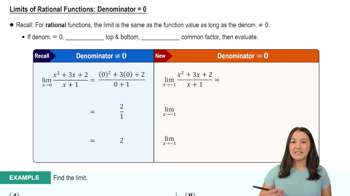
Limits of Rational Functions: Denominator = 0

Behavior of composite functions and substitution

When dealing with limits involving composite functions like cos(√x), it helps to analyze the inner function's behavior first. Substituting variables or expressions can simplify the limit evaluation, especially when the argument approaches zero.
Recommended video:
3:48
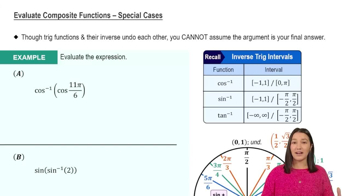
Evaluate Composite Functions - Special Cases

Exponential limits and the form 1^∞

Limits of the form (f(x))^(g(x)) where the base approaches 1 and the exponent approaches infinity often lead to an indeterminate form 1^∞. Applying logarithms and using L'Hôpital's Rule or series expansions helps to resolve such limits.
Recommended video:
6:13
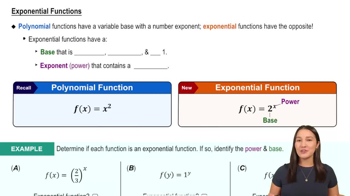
Exponential Functions