Ch. 7 - Transcendental Functions
Hass - Thomas' Calculus 15th Edition
Hass15th EditionThomas' CalculusISBN: 9780137616077Not the one you use?Change textbook
Chapter 7, Problem 7.AAE.1

Find the limits in Exercises 1–6.
1. lim(b→1⁻) ∫(from 0 to b) dx/√(1-x²)

Verified step by step guidance
1
Recognize that the integral \( \int_0^b \frac{dx}{\sqrt{1 - x^2}} \) represents the inverse sine function, since \( \frac{d}{dx} \arcsin x = \frac{1}{\sqrt{1 - x^2}} \).
Rewrite the integral using the antiderivative: \( \int_0^b \frac{dx}{\sqrt{1 - x^2}} = \arcsin b - \arcsin 0 \).
Evaluate \( \arcsin 0 \), which is 0, so the integral simplifies to \( \arcsin b \).
Set up the limit expression as \( \lim_{b \to 1^-} \arcsin b \), where \( b \) approaches 1 from the left side.
Recall the value of \( \arcsin 1 \) and use it to determine the limit of the integral as \( b \) approaches 1 from the left.

Verified video answer for a similar problem:

This video solution was recommended by our tutors as helpful for the problem above.
Video duration:
3m
Was this helpful?

Key Concepts

Here are the essential concepts you must grasp in order to answer the question correctly.

Definite Integral as a Limit of Riemann Sums

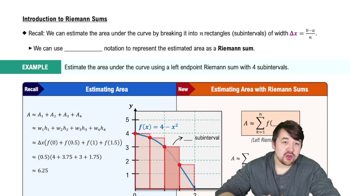
A definite integral represents the accumulation of quantities, such as area under a curve, between two limits. It is defined as the limit of Riemann sums as the partition gets finer. Understanding this helps interpret the integral ∫₀ᵇ 1/√(1-x²) dx as a function of the upper limit b.
Recommended video:
06:11
Introduction to Riemann Sums

Limit of a Function from the Left (One-Sided Limit)

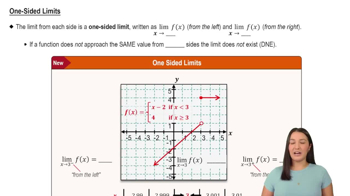
A left-hand limit, denoted as lim(b→1⁻), considers values of b approaching 1 from values less than 1. This concept is crucial when the function or integral behaves differently near the boundary, ensuring the limit is evaluated correctly as b approaches 1 from below.
Recommended video:
05:50
One-Sided Limits

Integral of 1/√(1 - x²) and its Connection to Inverse Trigonometric Functions

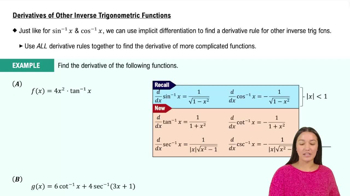
The integral of 1/√(1 - x²) with respect to x is arcsin(x) + C. Recognizing this allows direct evaluation of the definite integral by applying the Fundamental Theorem of Calculus, simplifying the limit problem to evaluating arcsin(b) as b approaches 1 from the left.
Recommended video:
06:35
Derivatives of Other Inverse Trigonometric Functions