Ch. 7 - Logarithmic, Exponential Functions, and Hyperbolic Functions
Briggs - Calculus: Early Transcendentals 3rd Edition
Briggs3rd EditionCalculus: Early TranscendentalsISBN: 9780136847243Not the one you use?Change textbook
Chapter 7, Problem 7.1.73b

Properties of exp(x) Use the inverse relations between ln x and exp(x), and the properties of ln x, to prove the following properties:


b. exp(x − y) = exp(x) / exp(y)

Verified step by step guidance
1
Recall that the exponential function \( \exp(x) \) and the natural logarithm \( \ln(x) \) are inverse functions, meaning \( \exp(\ln(x)) = x \) for \( x > 0 \) and \( \ln(\exp(x)) = x \) for all real \( x \).
Start with the expression \( \exp(x - y) \). Since \( \exp \) and \( \ln \) are inverses, write \( \exp(x - y) = \exp(\ln(\exp(x - y))) \).
Use the property of logarithms that \( \ln(a/b) = \ln(a) - \ln(b) \). To apply this, rewrite \( x - y \) as \( \ln(\exp(x)) - \ln(\exp(y)) \) because \( \ln(\exp(x)) = x \) and \( \ln(\exp(y)) = y \).
Substitute back into the exponential function: \( \exp(x - y) = \exp(\ln(\exp(x)) - \ln(\exp(y))) \). Using the logarithm property, this equals \( \exp(\ln(\exp(x)/\exp(y))) \).
Since \( \exp \) and \( \ln \) are inverse functions, \( \exp(\ln(\exp(x)/\exp(y))) = \exp(x)/\exp(y) \). Thus, we have shown that \( \exp(x - y) = \frac{\exp(x)}{\exp(y)} \).

Verified video answer for a similar problem:

This video solution was recommended by our tutors as helpful for the problem above.
Video duration:
3m
Was this helpful?

Key Concepts

Here are the essential concepts you must grasp in order to answer the question correctly.

Inverse Relationship Between exp(x) and ln(x)

The exponential function exp(x) and the natural logarithm ln(x) are inverse functions, meaning exp(ln(x)) = x for x > 0 and ln(exp(x)) = x for all real x. This relationship allows us to switch between exponential and logarithmic forms to simplify expressions and prove identities.
Recommended video:
03:39
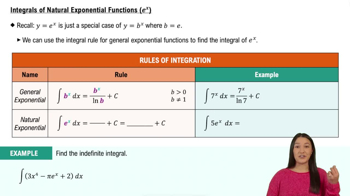
Integrals of Natural Exponential Functions (e^x)

Properties of the Natural Logarithm ln(x)

The natural logarithm has key properties such as ln(ab) = ln(a) + ln(b) and ln(a/b) = ln(a) - ln(b) for positive a and b. These properties help break down complex expressions into simpler parts, which is essential when manipulating expressions involving exp(x) through their logarithmic counterparts.
Recommended video:
05:18
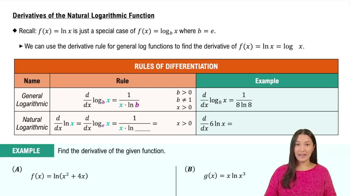
Derivative of the Natural Logarithmic Function

Exponential Function Laws

The exponential function satisfies laws similar to those of powers, including exp(x + y) = exp(x) * exp(y) and exp(0) = 1. Using these laws, one can rewrite expressions like exp(x - y) as exp(x) / exp(y), which is the property to be proven.
Recommended video:
6:13
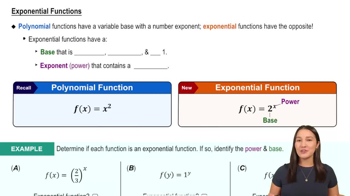
Exponential Functions
Related Practice
Textbook Question

Oil consumption Starting in 2018 (t=0), the rate at which oil is consumed by a small country increases at a rate of 1.5%/yr, starting with an initial rate of 1.2 million barrels/yr.


b. Find the function that gives the amount of oil consumed between t=0 and any future time t.

Textbook Question

Chemotherapy In an experimental study at Dartmouth College, mice with tumors were treated with the chemotherapeutic drug Cisplatin. Before treatment, the tumors consisted entirely of clonogenic cells that divide rapidly, causing the tumors to double in size every 2.9 days. Immediately after treatment, 99% of the cells in the tumor became quiescent cells which do not divide and lose 50% of their volume every 5.7 days. For a particular mouse, assume the tumor size is 0.5 cm³ at the time of treatment.

a. Find an exponential decay function V₁(t) that equals the total volume of the quiescent cells in the tumor t days after treatment.

Textbook Question

37–38. Caffeine After an individual drinks a beverage containing caffeine, the amount of caffeine in the bloodstream can be modeled by an exponential decay function, with a half-life that depends on several factors, including age and body weight. For the sake of simplicity, assume the caffeine in the following drinks immediately enters the bloodstream upon consumption.


An individual consumes two cups of coffee, each containing 90 mg of caffeine, two hours apart. Assume the half-life of caffeine for this individual is 5.7 hours.


b. Determine the amount of caffeine in the bloodstream 1 hour after drinking the second cup of coffee.

Textbook Question

Depreciation of equipment A large die-casting machine used to make automobile engine blocks is purchased for \$2.5 million. For tax purposes, the value of the machine can be depreciated by 6.8% of its current value each year.


a. What is the value of the machine after 10 years?

Textbook Question

"Integral formula Carry out the following steps to derive the formula ∫ csch x dx = ln |tanh(x / 2)| + C (Theorem 7.6).


b. Use the identity for sinh(2u) to show that 2 / sinh(2u) = sech² u / tanh u."

Textbook Question

A slowing race Starting at the same time and place, Abe and Bob race, running at velocities u(t) = 4 / (t + 1) mi/hr and v(t) = 4e^(−t/2) mi/hr, respectively, for t ≥ 0.

b. Find and graph the position functions of both runners. Which runner can run only a finite distance in an unlimited amount of time?