Ch. 11 - Parametric Equations and Polar Coordinates
Hass - Thomas' Calculus 15th Edition
Hass15th EditionThomas' CalculusISBN: 9780137616077Not the one you use?Change textbook
Chapter 11, Problem 11.5.27

Finding Lengths of Polar Curves


Find the lengths of the curves in Exercises 21–28.


The curve r = cos³(θ/3), 0 ≤ θ ≤ π/4

Verified step by step guidance
1
Recall the formula for the length of a curve given in polar coordinates: the arc length \( L \) from \( \theta = a \) to \( \theta = b \) is given by \[ L = \int_a^b \sqrt{r(\theta)^2 + \left(\frac{dr}{d\theta}\right)^2} \, d\theta \]
Identify the given function and interval: \( r(\theta) = \cos^3\left(\frac{\theta}{3}\right) \) and \( 0 \leq \theta \leq \frac{\pi}{4} \).
Compute the derivative \( \frac{dr}{d\theta} \) using the chain rule: First, write \( r(\theta) = \left( \cos\left(\frac{\theta}{3}\right) \right)^3 \). Then, \[ \frac{dr}{d\theta} = 3 \cos^2\left(\frac{\theta}{3}\right) \cdot \left(-\sin\left(\frac{\theta}{3}\right)\right) \cdot \frac{1}{3} \] Simplify this expression.
Substitute \( r(\theta) \) and \( \frac{dr}{d\theta} \) into the arc length formula: \[ L = \int_0^{\frac{\pi}{4}} \sqrt{ \left( \cos^3\left(\frac{\theta}{3}\right) \right)^2 + \left( \frac{dr}{d\theta} \right)^2 } \, d\theta \]
Set up the integral with the simplified expressions and prepare to evaluate it either analytically (if possible) or numerically to find the length of the curve.

Verified video answer for a similar problem:

This video solution was recommended by our tutors as helpful for the problem above.
Video duration:
9m
Was this helpful?

Key Concepts

Here are the essential concepts you must grasp in order to answer the question correctly.

Arc Length of Polar Curves

The arc length of a curve defined in polar coordinates r(θ) from θ = a to θ = b is found using the formula L = ∫ from a to b √[r(θ)² + (dr/dθ)²] dθ. This formula accounts for both the radial distance and the rate of change of r with respect to θ, providing the total length of the curve.
Recommended video:
06:29
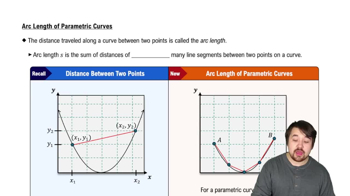
Arc Length of Parametric Curves

Differentiation of Polar Functions

To apply the arc length formula, you need to compute the derivative dr/dθ of the given polar function r(θ). This involves using chain and power rules, especially when r is expressed as a composite function like cos³(θ/3). Accurate differentiation is essential for evaluating the integral correctly.
Recommended video:
05:32
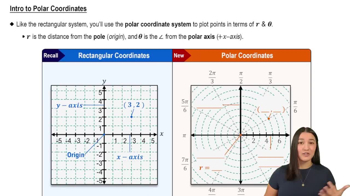
Intro to Polar Coordinates

Integration Techniques for Arc Length

After setting up the integral for arc length, you often need to simplify and evaluate it, which may require substitution or numerical methods if the integral is complex. Understanding how to handle trigonometric integrals and approximate definite integrals is crucial for finding the exact or approximate length.
Recommended video:
06:29
Arc Length of Parametric Curves