Ch. 11 - Parametric Equations and Polar Coordinates
Hass - Thomas' Calculus 15th Edition
Hass15th EditionThomas' CalculusISBN: 9780137616077Not the one you use?Change textbook
Chapter 11, Problem 11.1.24

Finding Cartesian from Parametric Equations


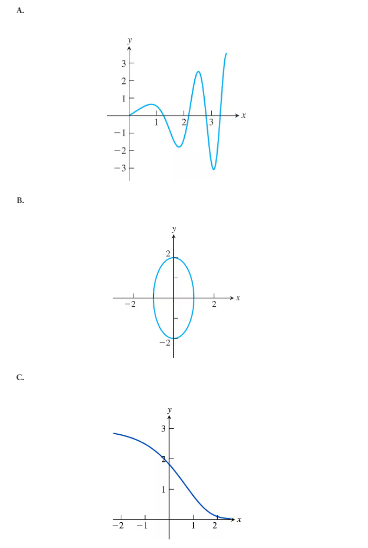
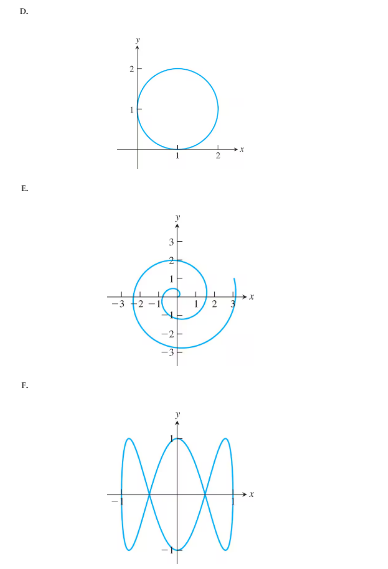
In Exercises 19–24, match the parametric equations with the parametric curves labeled A through F.


x = cos t, y = sin 3t


Graphs of three parametric curves labeled D, E, and F, showing a circle, a spiral, and a wave-like pattern.

Verified step by step guidance
1
Step 1: Identify the parametric equations given: \(x = \cos t\) and \(y = \sin 3t\).
Step 2: Understand the behavior of \(x = \cos t\): it oscillates between -1 and 1 with period \(2\pi\).
Step 3: Understand the behavior of \(y = \sin 3t\): it oscillates between -1 and 1 but with a period of \(\frac{2\pi}{3}\), which is three times faster than \(x\).
Step 4: Look for a graph where the \(x\)-values oscillate smoothly between -1 and 1, while the \(y\)-values oscillate more rapidly, creating multiple waves within one period of \(x\). This will create a pattern with three oscillations in \(y\) for every one oscillation in \(x\).
Step 5: Match this behavior to the graphs provided. The graph labeled F shows a wave pattern with multiple oscillations in \(y\) for each oscillation in \(x\), consistent with \(x = \cos t\) and \(y = \sin 3t\).

Verified video answer for a similar problem:

This video solution was recommended by our tutors as helpful for the problem above.
Video duration:
9m
Was this helpful?

Key Concepts

Here are the essential concepts you must grasp in order to answer the question correctly.

Parametric Equations

Parametric equations express the coordinates of points on a curve as functions of a parameter, usually denoted as t. Instead of y as a function of x, both x and y depend on t, allowing representation of more complex curves like loops or spirals.
Recommended video:
Guided course
08:02
Parameterizing Equations

Conversion to Cartesian Form

Converting parametric equations to Cartesian form involves eliminating the parameter t to find a direct relationship between x and y. This helps identify the shape of the curve and compare it to standard graphs, such as circles or ellipses.
Recommended video:
6:20
Circles in General Form

Trigonometric Parametric Curves

When parametric equations involve trigonometric functions like sine and cosine, the resulting curves often represent periodic or oscillatory shapes. Understanding how frequencies and amplitudes affect the curve is essential for matching equations to their graphs.
Recommended video:
06:49
Differentiation of Parametric Curves